Showing posts with label SD Worx. Show all posts

Wednesday, 8 November 2023

Freewheeling: Alpe d'Huez finale for the 2024 Tour de France Femmes could be spectacular

A spontaneous applause rippled through the audience at the Palais des Congres, Paris as Marion Rousse revealed Alpe d'Huez as the concluding stage of the 2024 Tour de France Femmes.

The auditorium, packed, with a couple of thousand people - a mixture of professional cycle racers, cycling industry executives, sponsors, sports associations, local government representatives, governing body chiefs, and sports media - had come to watch the grand presentation of the 2024 Tour de France and Tour de France Femmes routes. 

Discovering that Alpe d'Huez would feature proved popular. This iconic climb which has been a crowd puller since it was included in the men's Tour de France in 1952 has now been included in what will be the third edition of the women's Grande Boucle event, sponsored by Zwift and organised by ASO.

An iconic stage was also included in the previous Tour de France Femmes when the 2023 event included a stage through the Pyrenees with a finish on the Tourmalet, and the 2022 inaugural renaissance event concluded in the Vosges atop La Superplanche des Belles Filles. 

Having these iconic mountain stages in the women's races is great for the sport as it is bound to increase audience engagement in terms of television viewing and social media interactions. It is also a great endorsement from the organisers and sponsors that they would include such stages in the women's race. When it comes to the Tour de France, racing up Alpe d'Huez doesn't get better. Given the abundance of strong riders from the Netherlands in the women's peloton, Dutch corner will be a massive party for the women too! 

Other interesting points about the Tour de France Femmes are the Grand Départ taking place in Rotterdam - the first time the race is happening outside of French territory. With the initial stages being in the Netherlands and Belgium, the riders won't reach France until Stage 5. Considering that the race only has eight stages it's not so much a Tour de France but a Tour de BeneFrance!

On a positive note the areas covered the Hexagon will be well known roads to the cycling fan. Stages 2 and 3 are done on the same day, in Rotterdam, with Stage 3 being a 6.3km time trial. This is practically the same route as the prologue of the 2010 Tour de France, though slightly shorter. As in 2010 the riders will have mini climbs to do up Erasmus Bridge and Willems Bridge.

Stage 4, from Valkenberg to Liège will feature parts of the Amstel Gold race (the Cauberg), as well parts of Liège-Bastogne-Liege (La Redoute, Côte des Forges, and others).

The 167km Stage 7, from Champagnole to Le Grand Bornand, the longest stage will be an extended version of La Course by the Le Tour de France 2018 and will pass by Lac d'Annecy,  though with a preamble over climbs through the Jura. This stage will be a tasty appetiser before the grand finale, from Le Grand Bornand to Alpe d'Huez, passing via col de la Tamié, Col de Glandon, Barrage de Grand' Maison and then from Le Bourg d'Oisans up the 21 hairpins to the most famous ski resorts in cycling history. 

So the stage is set for some royal battles. We just need the actors to play their part. Without wanting to put a fine point on it I think that there is an onus on the athletes to give the fans a spectacle. It is these stories of rivalry and show-downs on the streets of the Tour de France (and the Netherlands and Belgium) that garner more public interest and capture the imagination of the fans. 

While it's great to see Annemiek Van Vleuten type athlete showing up and demonstrating pure dominance at a few races, doing it at every race or all the way through a stage race is not necessarily what engages spectators. Having one other rival is better, but still not that interesting if the rest of the field is so far behind. We remember how Van Vleuten audaciously snatched victory from Anna van der Breggen in the final metres of the race. But who remembers what the other riders did? Third placed Ashleigh Moolman-Pasio crossed the finish line well over a minute behind the two Dutch women.

What is needed is more depth. It is great to see races where it's not a given that such and such a rider will win, or that the winner will come from this really dominant team. (I'm looking at SD Worx here!)

Of course you can't reproach a rider or a team for being so much stronger than the others. We just need to see more challengers coming through. We got a flavour of that in 2023 Tour de France Femmes when Kasia Nieuwiadoma of Canyon SRAM went for it on the Tourmalet climb, and subsequently won the Queen of the Mountains jersey. We also saw that when some younger riders like Yara Kastelijn (Fenix-Deceuninck) won a stage, and also when a couple of riders (other than Annemiek Van Vleuten) from Team Movistar won stages.

Also, with this year's event starting and passing through countries that harbour an avid cycling fan base there is likely to be greater interest than in previous years especially as there will be many Dutch riders contesting the top spots.

Furthermore, the variety in the profile of races means that there is something for everyone - for the Classics rider, the mountain goat, or the sprinter. Considering that this is only a seven-day race, the organisers have cleverly packed in stages that should leave no shortage of drama for we fans over that week in mid-August. I look forward to seeing who will be wearing the yellow jersey at the summit of Alpe d'Huez after seven days and 946km of racing. 

Monday, 31 July 2023

Women's Tour de France delivers drama and new stars

Tour de France Femmes peloton on the stage to Albi (photo: Thomas Maheux)

Following the successful staging of the reborn Tour de France Femmes in 2022, this year's edition of the event, sponsored by Zwift didn't fail to disappoint.

Last year's women's Tour de France Femmes began to the fanfare of the women racing Stage 1 on the Champs Elysees a few hours before the men's concluding stage of their Tour de France. The women then contested their remaining stages of their Tour in the East of France, in the Alsace/Vosges area with an exciting finale on the Superplanche des Belles Filles.

I must admit that when I saw that this year's stage would be starting from Clermont Ferrand, it seemed a slight downer compared with the iconic landmarks of central Paris. Granted, the event was in the shadow of the Puy de Dome, but the famous road up the extinct volcano was not included in the women's race itinerary.

However, the race more than made up for it with the final stages snaking through the Pyrenees, over the col d'Aspin and the col du Tourmalet, culminating in a time trial on undulating roads around Pau. 

Lotte Kopecky (photo: Getty Sport)
What also makes the race are the riders. It was no surprise to see women from the mighty SD Worx team occupying the upper echelons of the General Classification rankings, but it wasn't totally one-way traffic for the Netherlands-registered team flush with National, European and former World Champions. This made the overall racing exciting and introduced an element of suspense - an important ingredient for an engaging sports competition.

Where the men's Tour de France solicited a guessing game about whether Tadej Pogacar or Jonas Vingegaard would come out on top, the women's race led to debates around whether it would be Movistar's Annemiek Van Vleuten who would replicate her triple Grand Tour victories from last year (she had already won the women's Vuelta a Espana, and Giro Donne) or whether Demi Vollering would stop her compatriot in her ascendancy.  

After Vollering drew first blood by thanks to the stage one victory by Belgian National Champion Lotte Kopecky, allowing her SD Worx team to seize the maillot jaune (yellow jersey) and keep it thanks to further stage victories from Lorena Wiebes (stage 3) and Marlen Reusser (stage 8). However the team was punished with setbacks which could have toppled its aspirations. In reality, these problems were self-inflicted and would have been associated more with a small newbie team, than with a dominant World Tour Team led by some of the most experienced riders and sports directors in the women's peloton.

On Stage 4 from Cahors to Rodez, won by a breakaway rider Yara Kastelijn (Fenix-Deceuninck), Vollering crossed the finish line in a celebratory mood, in second place after bursting forward from her group. She had not realised there was another rider further up the road who had won the stage - despite her having radio communication with her team mates and sports director, and knowing that there had been a breakaway which had as much as 10 minutes time advantage over the GC chasing group at one point.  

The following day, during Stage 5, SD Worx effected a bike change for Vollering when she got a puncture. Looking at the TV pictures, the bike change must have been the slowest change in the history of bike racing! Unsurprisingly the rider lost a significant amount of time on the peloton including her GC contender rivals, so she slipstreamed off her team car in order to be paced back to the bunch. 

It wasn't plain sailing for SD Worx (photo: Thomas Maheux)

The only problem was her sports director drove down the wrong side of the road, dangerously overtaking, and potentially putting other participants in danger. 

After an initial reprimand from the race commissaire during the race for excessive slipstreaming and dangerous overtaking, sports director Danny Stam received a 200CHF fine and Vollering received a 100CHF fine. Stam was later expelled from the race after dismissing the UCI commissaires' ruling as ridiculous. 

While SD Worx had the means to pay the fine and co-sports director Anna van der Breggen could still manage matters during the race, the real bite came when Vollering received a 20-second time penalty which relegated her from second to seventh place in the GC, and 12 seconds behind Van Vleuten. This was in addition to the double whammy of seeing Movistar's Emma Norsgaard (Jorgensen) sprint to win Stage 6 into Blagnac ahead of yellow jersey wearer, Kopecky on the eve of the decisive weekend for the race.

During the decisive penultimate stage from Lannemezan to Tourmalet, Van Vleuten and Vollering had a face-off on the lower slopes of the giant of the Pyrenees. There was no love lost between these two Dutch girls - even less so since last year's Tour de France Femmes, as well as this year's Vuelta a Espana when Vollering believed Van Vleuten had been unsporting en route to her historic win. [Van Vleuten allegedly attacked while Vollering, who was in the lead, took a loo break.]

Such stand-offs can actually be advantageous to others, as Canyon SRAM's Kasia Niewiadoma found when she launched her own attack off the front, staying away until shortly before the finish line when eventual winner Vollering caught her, though the Pole still stayed ahead of Van Vleuten by more than half-a-minute. Deservedly Niewiadoma was awarded the polka dot jersey for the Queen of the Mountains.

An emotional Demi Vollering on realising she's won the Tour de France Femmes (Thomas Maheux)

What we learned during this Tour de France Femmes was that contrary to fellow competitor Elisa Longo Borghini who once described Van Vleuten as an alien, the all-powerful Movistar rider is human. She began to show signs of weakness and fatigue as the route passed through the mountain villages of St Marie de Campan, and La Mongie, and the World Champion was unable to match Vollering's attack through the mist in the Hautes Pyrenees as she crossed the finish line over two and a half minutes ahead of Van Vleuten as the new wearer of the yellow jersey. 

Similarly, at the closing time trial, where Van Vleuten has traditionally prevailed, she was also caught wanting, when she finished in 14th place, over 1 minute 40 seconds behind Reusser.

So it wasn't to be for Vleuty, who finished in fourth place in the GC almost four minutes behind the victorious Vollering. Meanwhile the SD Worx camp enjoyed huge celebrations following Reusser's victory in the time trial, Lotte Kopecky's green jersey, and Vollering's maiden yellow jersey for her overall win at the Tour de France Femmes.

As well as the battle between these two arch-rivals, this Tour de France Femmes was also spiced up by young guns going for it - new riders, young riders, smaller teams, throwing themselves out there and trying their chances for a stage win.

A crash-filled Stage 2 saw Lianne Lippert take flight with a maiden victory. The young team-mate of Van Vleuten finished ahead of Kopecky who punctured before the finish line after being led out by Vollering. Stage 3 saw the dreams of Julie Van de Velde of the young team Fenix-Deceuninck crushed as she was caught agonisingly close to the finish line after launching a long breakaway. Her cyclocrosser team-mate Kastelijn (who eventually won the overall combativity prize) finished the business by winning Stage 4 into Rodez. 

Ricarda Bauernfeind, new kid on the block (Thomas Maheux)

In spectacular style Ricarda Bauernfeind, a recent arrival at Canyon-SRAM having been in the development structure Canyon-Generation took the biggest win of her short career in stage 5 (from Onet-le-Chateau to Albi) and at age 23 years and three months she became the youngest winner of a TDFF stage.

Additionally, the likes of Ashleigh Moolman-Pasio, racing for the newly formed AG Insurance-Soudal-Quick-Step team, whose sport director is former racer Jolien d'Hoore, also put time into Van Vleuten on the slopes of the Tourmalet. Kopecky who is known as a sprinter and also a handy track cyclist emerged as the Wout Van Aert of women's racing as she also put in a sterling ride in the mountains.

So all in all, the Tour de France Femmes this year turned out to be an engaging race, with interesting stories and talking points, excitement, intrigue, and new stars. 

As much as I like Van Vleuten and it would have been a good note on which the 40-year old could close out career, doing the triple, I must say that I am happy that there were a few twists and turns in the competition. Although SD Worx dominated in the rankings, we certainly saw fearless challenges from riders across the spectrum of age, experience, and team strength.

                              Jersey winners: L-R: Cedrine Kerbaol, Kasia Niewiadoma, Demi Vollering,
Lotte Kopecky (photo: Thomas Maheux) 

Next year's Tour de France Femmes with Zwift will start in the Netherlands, and we will find out the full itinerary in October. I look forward to seeing what 2024 will bring.


Related posts

Freewheeling: Is women's professional cycling in a good place?

52 Cycling Voices - Kimberley Coates

The Tour de France Femmes est arrivée

52 Cycling Voices - Pauline Ballet

52 Cycling Voices - Rochelle Gilmore

Monday, 24 April 2023

Freewheeling: Is women's professional cycle racing in a good place?

Demi Vollering wins Liege-Bastogne-Liege @GettySport

Phew, it's been breathtaking watching how the races have unfolded during this year's Spring Classics races - those tough one-day races in northern France, Belgium and the Netherlands over windswept, sometimes cobbled, sometimes undulating terrain, often in the rain. No one must be more out of breath than SD Worx rider Demi Vollering, who completed the Ardennes Classics triple in scintillating style by winning the Amstel Gold, Flèche-Wallone, and Liège-Bastogne-Liege - a feat last achieved by her mentor and team Sports Director, Anna van der Breggen in 2017.

As women's professional cycling continues to grow and more is being done to achieve parity with men's cycle racing, it is worth doing a stop and check, and asking if women's professional cycle racing really is in a good place?


Vive Le Tour de France Femmes

It has been great to see that sports event organiser Amaury Sports Organisation (ASO) continue to add to its sports portfolio by staging the Paris-Roubaix Femmes and a Tour de France Femmes. Last year's renaissance competition caught the eye of millions as the women raced around the streets of Paris on that hot Sunday afternoon during Stage 1 in the last week of July, right before the men raced the traditional finale. For many, it was an emotional day to see a women's peloton starting the stage race using the infrastructure of the iconic cycle race - something for which the likes of former professional cyclist Kathryn Bertine, and others including multiple World Champion Marianne Vos have campaigned for decades.

ASO were very happy with the viewing figures in France, with 20 million viewers on France 2 and France 3 free-to-air television channels across the whole race. There were on average 2.25 million viewers per day, making an audience share of 26.4%, and notably 5.1 million during the showdown between Vollering and Annemiek Van Vleuten on the final stage, on La Super Planche des Belles Filles. Across Europe 14 million viewers in seven countries tuned into fee-paying Eurosport. Naturally ratings were solid in the Netherlands with audience share of its national TV station, NOS being 45% as fans tuned in to watch their compatriot heroes race their way onto the podium and don the winning jerseys - Van Vleuten in yellow, Vollering in polka dots, Vos in green, and Shirin Van Anrooij in white. 

British hopes would normally have been placed on the top road racer, Lizzie Deignan, who won the inaugural Paris-Roubaix Femmes, but she was away on maternity leave. That will have impacted on viewing figures on this side of the English Channel.
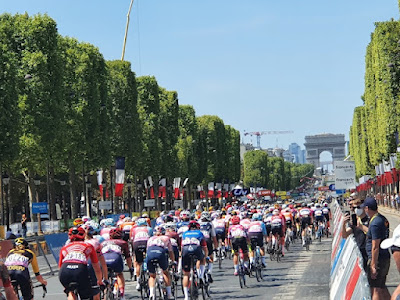
Stage 1 of 2022 revived Tour de France Femmes

Meanwhile in France, crowds came out in force along the road sides for key stages in Paris, on the gravel roads into Bar-sur-Aube during Stage Four, and at the finale on the slopes of the Vosgian mountain passes. But even Tour Director, Marion Rousse said that there were questions to be asked around the lack of roadside spectators on other stages.

In some cycle races, local schools get the children to come out of their classrooms to watch the race, and make some noise. That generally makes for good viewing to see crowds of young, excited faces and their high pitched cheers ring out loudly as the television cameras pan through the town centres. But with the Tour de France Femmes being in late July, many schools are already closed for the holidays. 


Growth is in the eyeballs of the beholder

Very importantly, the number of eyeballs on a race is a key factor in the growth of any sport. It's important to have the viewing figures, and it also looks good for viewers when they watch images of competitors battling it out in front of enthusiastic crowds. 

While sports fans avidly watch their athletic heroes performing well, they also like the stories and the characters behind the sport - the professional who was just a weekend warrior barely a year previously; the outspoken activist; the rivalries - between teams or even within a team; the bad boy/girl; the athlete making a come-back following a serious injury or illness.

The highly successful Netflix Formula 1 docusoap Drive to Survive has consistently attracted the same comment - "I don't follow F1; I don't know anything about motorsport; but I am fascinated by the characters and the stories."

Personally, I think we need a bit of that in cycling, and particularly in women's professional cycling. Cycling fans marvel on social media over who they believe to be the GOAT (greatest of all time) - be it Marianne Vos or Annemiek Van Vleuten in the modern era, Beryl Burton from the vintage times, or Jeannie Longo if they want to go for a controversial choice. Whoever your don't want athletes who when they are interviewed are just a bit too.....I dare say, "ordinary"! Many of these athletes just talk about their racing, their calendar, their strategy, and they will have been media-prepped to not stray off that line. That's all well and good for the purist fan. But a sport cannot live on purists alone. There needs to be an extra dimension that can attract a wider audience and give a wow factor - or at least a story that chimes with observers.
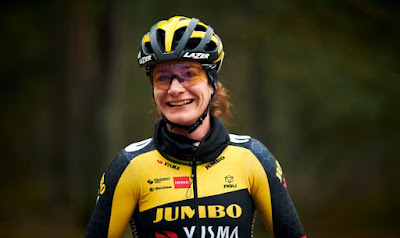
Marianne Vos, for many the GOAT

Recently, a camera crew on the famous Koppenberg climb on the route of the Tour of Flanders, asked a group of women riders to move out of the way so that they could film one of the top men's teams doing their training ride over the cobbles. 

The camera crew failed to recognise that among the women they budged out was a certain Lotte Kopecky - defending champion of the race, a native of Flanders (voted Flandrian of the Year) as well as being winner of other classics like Het Nieuwsblad and Strade Bianche, plus a multiple World and European Track cycling champion. 

I previously wrote an article in Rouleur magazine about a big sporting rivalry in the 1980s - not Borg and McEnroe, but Longo and Canins. Two of the best women riders of that era, who dominated the erstwhile Tour de France Feminin. Jeannie Longo was a former Alpine skier from the French Alps, while Maria Canins was a former cross country skier from the Italian Dolomites. A young firebrand demoiselle against la mamma volante (on account of her juggling her racing with being a mother). This rivalry filled column inches of the sports pages and garnered curious as well as dedicated fans to support team Longo or team Canins. Both women have reminisced whimsically about those days when they had their faces plastered on the front of popular sports newspapers like Gazzetto dello Sport or L'Equipe. Longo also appeared on sports shows on French television. 


Everybody loves a story - where is it? We need it! 

Among the sea of women's teams today, a couple of frontrunners have emerged in the race for World Tour supremacy, with both teams having a clutch of World and National Champions in their fold. I'm talking about Trek-Segafredo and SD Worx. Wouldn't things be spiced up if we had a Manchester City v Arsenal type rivalry going on?

While there are quite a few riders who have shown true grit on the road, there don't seem to be any real characters that do acts that go beyond sport. Cecilie Uttrup Ludwig's trademark effusive post-race interviews attract interest and have brought her a significant following, and a comparatively less well-known Canadian, Alison Jackson - the surprise winner of Paris-Roubaix Femmes - got people talking as much about her sporting achievement as for her post-race dances on social media. But it seems to be limited to that. Let's hope Alison wins a few more races.

In short, we see some great racing in the women's game and there are some outstanding riders. But we could do with more characters and back-stories to make the sport. That's what garners a wider interest than just pure sport, and what brings more eyeballs, and hence increasing TV deals, and sponsorship. We all want to see our favourite sport on television, but clearly given the costs of televising a sport event, there needs to be something in it for the organisers who would sell the rights, and the broadcast companies who purchase the rights, and ultimately the sponsors and advertisers who are hoping to get the visibility and the returns. 

There needs to be solid evidence that loads of people will watch the event on TV. The Tour de France Femmes last year was deemed a success in terms of viewing figures which is great, but that scenario needs to be replicated again and again across the collection of big races in the racing calendar. As annoying as it may be that a women's cycle race isn't shown on terrestrial TV, it has to be kept in mind that it's an ambitious expectation to see a race televised if viewing figures are measured in the thousands - which is not uncommon for some World Tour races -  rather than in the millions.  
Sadly, sponsorship was lacking when it came to the Women's Tour of Britain race. The week-long stage competition had been running since 2014, attracting the best riders in the world, and was a paragon of parity in sport, with the race being televised on terrestrial free-to-air TV in the UK, and offering over a 90,000-euro prize fund - equal to the men's Tour of Britain, and more generous than other World Tour races apart from the Ride London Classique, and the later revived Tour de France Femmes.

But the organisers, Sweetspot, could not sustain this model and find a company willing to become the headline sponsor once the OVO Energy sponsorship ended after 2019. The event took place in 2022 but without a headline sponsor, but this could not continue for 2023. With funds desperately needed following the departure of other sponsors of the winners' jerseys and a vehicle sponsor, crowd funding was set up to try to make up the £500,000 shortfall. Sadly, there was no light at the end of the tunnel for this year.

The organisers, hope to hold the race in 2024, but that remains to be seen. The Vårgårda one-day race in Sweden has been stopped altogether due to economic reasons. Meanwhile, the women's Vuelta a España race, which had been held over one or two days in the September (and known as the Challenge Madrid) has been brought forward to May and will be a week-long stage race. The inaugural women's United Arab Emirates Tour took place in February over four days, and two newish stage races - the Tour de Suisse and the Tour de Romandie continue to establish themselves in the women's racing calendar. The women's calendar is busier than ever with 27 races (including 13 stage races) on the calendar, up from 23 in 2022. This is a far cry from the 17 races (including four stage races) when the calendar was established in 2016.

On paper professional women appear to have significantly less racing to do than their male counterparts who have 20 one-day races and 15 stage races (of which three are three weeks long) on their calendar. But in fact a men's team has around 30 riders in its squad, with an average of 12 sports directors/associate sports directors, so they can run dual squads in parallel. Women's teams don't have the resources to do that, especially as many teams will have just one or two sports directors, and 15 riders to fill the calendar. It is not uncommon for teams to run overlapping squads, and some also have a development squad too, but still, athletes can quickly become maxed out in racing if there are any injury or illness issues. This was a problem for Trek-Segafredo, which led to Lizzie Deignan returning to racing slightly earlier than planned. 

Some of the smaller World Tour Teams have said that the changes in structure and conditions in women's professional racing - increased minimum wages, greater prize money, television coverage, maternity pay - are very welcome, even long overdue. However, this can only be sustained with more cash, which can be challenging to find and sustain.

In the words of a UK Prime Minister, "There is no magic money tree".


Hoping for a great future

As well as the unfortunate absence of a few races from the 2023, in the last couple of years teams have spectacularly folded, among them Team Virtu Cycling, Paule Ka, and B&B Hotels - which led to Chloe Hosking unexpectedly facing the prospect of an early retirement from racing. Lifeplus-Wahoo had previously been a World Tour team (when sponsored Trek), but sponsorship issues led to the outfit dropping down to a Continental team status. As for Zaaf Cycling Team, this has been a catastrophe with several riders leaving, including French National Champion Audrey Cordon-Ragot (who had also been a casualty of the B&B Hotels fall-out) after there were reports of riders and staff not being paid.

Development in women's professional sport is always a good thing. But it is also important that any growth be sustainable. This apparent boom in women's professional cycle racing will do wonders for the future of the sport - for athletes, businesses, media, and inspiring more girls and women to get on a bicycle. But the proportionate financial support needs to be there to keep things going, and there needs to be an incentive for corporations to want to pour money into the sport. 

Serena Williams 

In my opinion, the incentive comes down to eyeballs - maybe a Megan Rapinoe moment, which raised the profile of women's football during the 2019 Fifa Football World Cup, or a Serena (Williams) Slam, circa 2003 and with the matching flamboyance and character - or is it sacrilege if I mention a Lance Armstrong moment - but without the industrial scale doping programme and bullying.
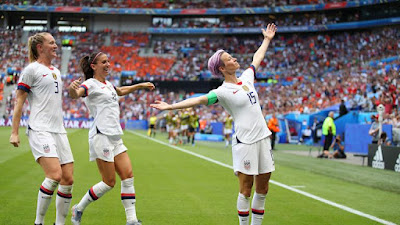
Megan Rapinoe at the 2019 football World Cup

Putting women's professional cycling properly on the map like sports such as football or tennis is easier said than done, at a time when professional women's cycle racing is finding its climbing legs. But I think the gains for the sport would be significant, and can move it from it's current reasonably good place, to a great place.


Related posts

52 Cycling Voices - 35: Kimberly Coats

52 Cycling Voices - 32: Emma Wade

Farewell Look Mum No Hands!

Le Tour de France Femmes est Arrivee

Wednesday, 29 September 2021

Photo of the day - 29: Catching up with SD Worx ahead of Paris-Roubaix Femmes


There's been a buzz this week as folks gear up for the inaugural Paris-Roubaix Femmes race. The Paris-Roubaix is one of the oldest professional bike races, and arguably the most gruelling one-day race. The full distance is 258km (161 miles) and the last 160km include 30 sections of cobbled roads (pavés) with most sections being between 1.5 and 4 km long - a total of 55km of pavés. These cobbles aren't of the neat variety that you find in quaint touristic towns or even the ones you see during the Tour of Flanders bike race. They are just jagged, irregular rough and ready cobbles of all shapes and sizes on old narrow roads. Riding your bike along them is a massive test in bike handling and resilience on your body. When it rains it's treacherous, as has been seen over the years in the men's race. 

After a lot of campaigning for a women's race, the organisers ASO finally decided to stage the race last year. Unfortunately, like with many events during these coronavirus times the race had to be postponed twice, and so we now have the race taking place this coming Saturday. It's going to be a real moment in cycling history.
The women's race will be a shorter version of the men's race, with the distance being 116.4km (70 miles) and 17 sections (29.2km) of pavés. The women will tackle iconic sections of Mons-en-Pévèle and Carrefour de L'Arbre, though it doesn't include the Trouée d'Arenberg.

Given the magnitude and excitement of the occasion, I was keen to talk to as many women as I could in advance, as part of an article I was writing for Cycling News website. One of the teams definitely worth speaking to was SD Worx, with its star-studded riders and a couple of riders who could be in with a realistic chance of winning.

So today, for my article in Cycling News, I spoke to Chantal van den Broek-Blaak, Christine Majerus, and Jolien d'Hoore, who is retiring from professional racing straight after the Paris-Roubaix Femmes. As expected, all three riders are very excited at the prospect of competing in this race. 

They had just finished doing the reconnaissance of the course, and it was fair to say that they all found it a very tough course, that is going to be risky if it is raining. None of the women were concerned by the fact that they won't be doing all of the iconic stretches of cobblestones, or even that the fact that the race is less than half the distance of the men's race. For them, it was the fact that there is a women's Paris-Roubaix at all, and that in itself is a good thing.