Showing posts with label Paris. Show all posts

Saturday, 23 September 2023

One day one photo - 23: Bois de Vincennes, my favourite Parisian park

Lac Daumesnil, Bois de Vincennes 

I love going to the Bois de Vincennes, one of the two extensive green spaces at either end of Central Paris. Almost every time I visit Paris I go there. Sometimes I ride through it and stop for a little picnic, like the last time I was in Paris. Other times I go for a run there or include it as part of a cycle commute. On other occasions, like today, I go for a stroll. 

Why not the Bois de Boulogne? You might ask. This other park on the West Side of Paris is also a very pleasant place to be, and in fact when I do a London to Paris cycle ride the last part of my ride often goes through the Bois de Boulogne. I must say, though, I find the Bois de Boulogne slightly busy and on some of the main roads you get boy racers zooming down it. From the early evening onwards you get a fair smattering of prostitutes too. It's not always that tranquil.

The thing of importance to me is the emotional connection I have with the Eastern side of Paris. For a few years I lived in the 12th arrondissement, near Porte Dorée, one of the entrances into the Bois de Vincennes. I would regularly run or walk around the Lac Daumesnil, and I would go for afternoon walks or picnics with friends. On a Saturday or Sunday afternoon I used to go to watch small concerts at the Parc Floral. 

On other Sundays when my local gym was closed I would go running around a waymarked route through the woods, starting and finishing at the Chateau de Vincennes and taking in the Lac des Minimes.

You can also go rowing, too though I haven't tended to do that much. I wonder if they'll allow paddleboarding?

These days when I go to Paris I tend to stay in and around Vincennes, and being near these woods makes for an oasis of calm, away from the hustle and bustle of the Paris metropolitan area. 

So after my morning Swim at the Yvonne Godard pool today I took the tram down to Porte Dorée for a little walk, ahead of my Paris-Versailles run. 

It was a real treat to be there in the morning while it was quiet, with just joggers and a few swans. 

Having this 2,500-acre parkland and woodland, slightly larger than Richmond Park in South London, definitely gives my trips a countryside feel where I can be in touch with nature and relax in one of the World's major cities. So I must say a big thank you to Napoleon Bonaparte and Baron Haussman, who in the 1850s had the idea to create a green space for the working class in Eastern Paris. Mind you, as I look around the nearby 12th arrondissement, and suburbs like Vincennes, Saint-Mandé or Saint-Maurice it seems pretty middle class!

Saturday, 1 July 2023

As featured in Rouleur magazine: Groupe Amaury

As with most cycling magazines during the month July, Rouleur (issue 120) has dedicated its issue to the Tour de France.

I am very happy to have my interview article on the Amaury Group featured. Groupe Amaury (as the French company is officially known) is the family-run parent company of Amaury Sports Organisation, the organisers of Tour de France and many other large-scale cycle races and sports events. 


The interview was with the joint Chief Executive Officers, siblings Jean-Etienne and Aurore Amaury. I had the pleasure of going to the ASO offices on the edge of Paris to meet them, earlier this year.

My visit took me to a four-storey glassy building at Boulogne-Billancourt overlooking the river Seine close to the Ile Saint Germain, and I got there quite easily by taking the metro from the Eurostar terminal at Gare du Nord, out to Marcel Sembat metro station. This was where the two main entities of Groupe Amaury, ASO and Equipe Media are housed.

On my arrival I was met in the buzzing reception by Lara, the executive assistant to the Jean-Etienne, Aurore, and their mother, Marie-Odile, who is still president of the organisation. I interviewed each of the siblings in turn in a meeting room on the top floor of the building. Apart from when Jean-Etienne greeted me in English (a language he speaks fluently after having studied in California, and previously worked for Bloomberg in London) all interviews were conducted in French.


Both Jean-Etienne and Aurore were friendly and amenable, and I was particularly appreciative of Jean-Etienne giving an hour of his time for the interview. Bear in mind that the Amaury family do not normally speak to the media, and hardly ever give interviews. I was therefore honoured to have had the opportunity to speak to the siblings (and also Marie-Odile a couple of years ago for another cycling publication). 

Jean-Etienne heads up ASO, whose principle activity is sports events. So it was also good to talk to him not just about the Tour de France but also other events that I had taken part in - the Etape du Tour, Paris Marathon, and the Paris Triathlon.

Aurore is the president of Equipe Media, which includes the daily sports newspaper and magazine, the television channel, and the website. They also sponsor awards, notably the Ballon d'Or football event. She was quite excited about the build-up to the Paris Olympics, which will be a big event for the organisation. After the interviews I was then shown around the television studios. Interestingly, for all of the company's heritage in cycling, the highest viewing figures don't come from watching the pro peloton. Cycling comes third behind football and biathlon (cross country skiing and rifle shooting).


Through my interviews I got a good idea of the family and how they tick. They seemed very down-to-earth and don't have any particular airs and graces. They are proud to be part of an event that is at the heart of French culture - the Tour de France. Sport is a very important part of their lives, and their mission is to make it available on a professional as well as mass participation scale. So it is unlikely that they would be selling any of their brands any time soon, despite different approaches to buy the Tour de France at different moments in history. 

I am happy with the finished result of the article and the way it looks, especially with the photographs taken of them by James Startt.

After my morning spent at ASO/Equipe Media I then went on a walk around the pleasant park on the Ile Saint-Germain, and on to Issy les Moulineaux, passing through the undulating Jardin Delphine Boulay from where there were impressive views of the Eiffel Tower. 

Then it was a case of catching the Metro into central Paris where I enjoyed a late lunch before returning to London.  


Related posts


Thursday, 29 June 2023

Wanna do the Paris Triathlon? What you need to know

Paris Triathlon details

  • The Paris Triathlon usually takes place in June. There is a sprint distance, which is what I did - 550m swim, 21km bike, 6km run - that takes place on the Saturday. The Olympic distance race - 1500m, 40km, 10km run on the Sunday.
  • The event is based at Parc de la Villette in the 19th arrondissement, with the swim taking place in the Ourcq Canal. 
  • The bike route goes into central Paris and back, passing some well-known landmarks. On both distances you go via the Canal St Martin to Republique, through Bastille, and along the River. In the sprint race the riders do a U-turn at Place de la Concorde to return to Parc de la Villette. 
  • In the Olympic distance the riders go up Champs Elysees and do a stint through the Bois de Boulogne before returning to the triathlon event village. 
  • Parts of the course have cobbles, though not extensively. Also be careful of sharp right or left-hand turns, and check around you before changing your line.
  • The race is supposedly non-drafting, but with the numbers and on this type of fast, mainly flat course it's hard to avoid doing so!
  • The run goes up one side of the Ourcq Canal, heading East to the suburb of Pantin, then crosses the canal at the half-way point to head back to the finish line in the event village.
  • This year, for the first time they included a duathlon, based on the distances in the sprint triathlon. Competitors did the same as the sprint triathletes but the swim was replaced with a 5km run.
  • Around 5000 athletes take part across all three distances over the two days.
  • It's a mass participation event open to anyone fit enough. The sprint triathlon is accessible to people who are new to the sport, with a cut-off time of around 3 hours to complete the race.
  • To take part, you need to have either a medical certificate stating a non-contraindication to doing competitive triathlons, or a triathlon licence from your country's triathlon federation. If you don't have an annual French Triathlon Federation licence you need to buy a French Triathlon Federation day licence for a nominal fee.
  • Given the numbers of people taking part in the event, you need to rack your bike in transition the day before the event.
  • The organisers seem quite relaxed about the closing date for entry. I entered the triathlon just a week prior to the event! But bear in mind that when uploading accompanying documents (triathlon licence/medical certificates) as part of the on-line entry process the organisers recommend that you allow a couple of weeks for them to validate your documents.
  • The events start around 7am, so you need to get public transport around 5.30/6am, depending on which part of Paris you're in. The metro is running at that time and the most convenient stop is Porte de Pantin on line 5.
  • On the morning of the event you need to be in your start pen about 30 minutes before your start time.
  • The walk from transition to the start pens is around 800m (half a mile) along grass, trails and cobbles. The organisers advise people to wear old trainers which can then be left in designated boxes and donated to charity. I didn't have old trainers so just wore a few pairs of old socks. 
  • As with all major events, there's a bit of a queue for the portaloos, so allow lots of time.
  • There is a staffed bag-drop area for your post-race gear, though there are no changing rooms or showers. Some people just got changed in the grassy area around the event. I was happy to cycle back to my lodgings after the race and get changed there. 
  • If you don't want to take your bike or a wetsuit, for an extra fee you can hire a "triathlon package" for the event from the organisers. It includes a bicycle and a wetsuit, plus other triathlon gear.
  • There's a great atmosphere at the event, with lots of spectators.
  • The 2024 date has not yet been announced, though it is possible to register your interest in order to receive news about it, including the date.

My logistics for the race
  • I travelled to Paris from London with my bike. I packed down my triathlon gear (including my wetsuit) very small so that they fitted into my bikepacking bags - one on the saddle, and the other on the handlebars. I also carried a small rucksack.
  • I caught a train from East Croydon to Brighton and then cycled to Newhaven. There was the option to catch a train from Brighton to Newhaven Town.  You can also go by train from East Croydon to Newhaven Town (with a changeover at Lewes). There was a further option to ride from Crystal Palace to Newhaven, but I didn't have the time to do that! Train tickets cost anything from £9 to £29 depending on which route you take, and if you book in advance on-line to travel on Thameslink or Southern Trains.
  • I got the 5pm ferry to Dieppe and arrived there at 10pm local time. Ferry tickets cost around £28 each way with DFDS, though can be a bit higher depending on the service.
  • My accommodation for the night was an apartment less than 10 minutes away from the Ferry terminal. Newhaven is quite a compact town. There are also reasonably priced hotels nearby. The flat cost around £40, while the hotels are a little bit more.
  • It was possible to get a train from Dieppe through to Paris (with changeover at Rouen). Both trains are regional (TER) so you just carry your bike on and put it in the provided bike space for free. You can buy tickets at the train station, but these days the French railway company, SNCF, are on a drive to get people to book on-line via their portal SNCF Connect. You are then more likely to get cheaper fares in advance. Also, if you book on-line then you can make changes to your ticket. Fares vary alot - from about 12 Euros to 30 Euros. 
  • If you're feeling really energetic you could ride the 120 miles all the way to Paris. Or you could go part way and ride about 35 miles to Rouen, or 60 miles to Beauvais then get a train to Paris. I cycled 20 miles to Auffay and then got on a train.
  • The train from Rouen arrives at Gare Saint-Lazare, while a train from Beauvais goes to Gare du Nord, both stations being in central Paris.
  • I stayed in an Aparthotel at Maisons-Alfort, a nearby suburb of Paris, just to the East and next to the 12th and 13th arrondissements of the city. It was close to the woods (Bois de Vincennes) and was on the metro (line 8, Balard-Creteil). Bear in mind that Paris is a very compact city, and although I was in the suburbs I was still only about a half-hour bike ride from the touristic parts of Central Paris.
  • Staying in an apartment meant that I could go self-catering and eat the food that suited me for the event. Where I stayed was very conveniently located close to a supermarket.
  • The triathlon took place in the Parc de la Villette, in the 19th arrondissement, North-East of Paris. It was about a 40-minute cycle ride from where I was staying. Once the triathlon was done it was an easy bike ride to get back to my lodgings.
  • The metro took around the same amount of time on the morning of the event, and involved a changeover at Bastille to get to Porte de Pantin.
  • Getting home to London was fairly straightforward. I got a train from Paris St Lazare in the late afternoon on Sunday and then took the overnight ferry to Newhaven, then cycled to Brighton to get the train to East Croydon. I was originally booked onto a Sunday morning train in order to get the afternoon ferry from Dieppe, but a puncture meant I missed my train. However, it was straightforward forward to change my train ticket on-line. As it was the weekend, DFDS phone line was closed, so I did have to buy a new ferry ticket. Then the next day I just transferred the original ticket to a another trip in the future. I will definitely be making a trip to Paris with my bike in the future. It's one of my favourite itineraries!

Related posts


Tuesday, 27 June 2023

Back again to Paris by bike - Part 1: Croydon to Rouen

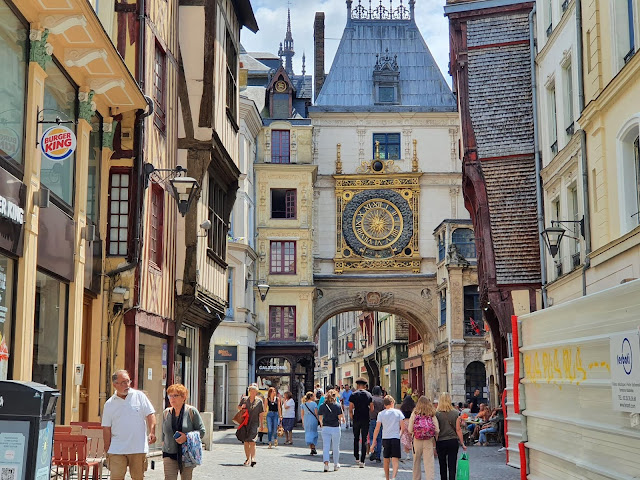
Le Grand Horloge, Rouen

Every time I plan a trip to Paris by bicycle I tell myself "this time I will ride from London to the port at Newhaven." After all, it is just like doing a London to Brighton bike ride, but finishing slightly further to the east, and then letting the boat carry you to foreign shores  well France.

However, when the day comes it just doesn't happen. Too many things to do at home - chores to do, work to complete, deadlines to meet, or just tidying the house means that I get to lunchtime, get stressed that I've cut things fine. I also realise the amount of luggage I have packed won't allow me to ride at a decent enough pace. So I take the "easy living" option. And that's what happened today. I did a London to Brighton, except that it was by train! I took the 45-minute train journey from East Croydon to Brighton.

Trains to there are very frequent, and there is space for a bicycle, though because the train passes through Gatwick Airport, lots of folks with suitcases also want to hog the area. There are regular trains from Brighton to Newhaven Town, but in order to not feel like I had completely copped out of my cycle touring mission I rode the undulating 10 miles from Brighton to Newhaven port. 

Riding through Brighton is always a pleasant experience. The place seems a lot brighter than London, with it being right on the coast, and everyone and everything seems laid back as I amble along the promenade on the cycle path. Lots of folks are out on the pier, on the beach visiting i360 or are enjoying the rides at the fairground - even though it is a Thursday afternoon.


As I continue along on Madeira Drive, the road becomes more sparse as I pass the back-end of the city. Apart from the Marina and the New outdoor swimming venue, Sea Lanes there's nothing noteworthy. 
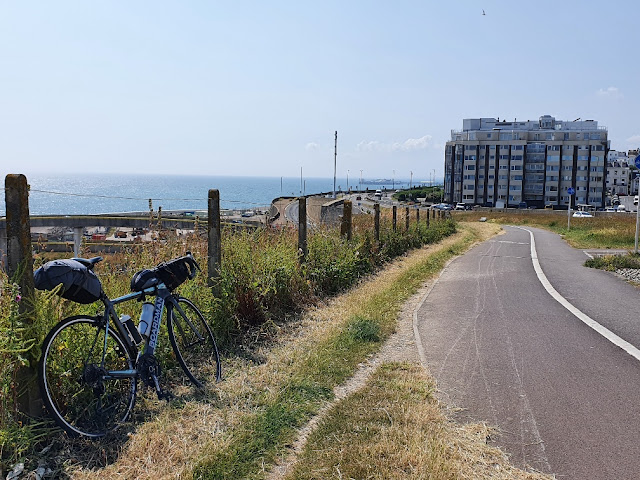

Leaving behind Brighton for the port of Newhaven

Then the coastal cycle path ceases to be flat, and joins the undulating coast road. That's when the work begins. From Roedean right up to Peacehaven the road had alternate descents and challenging rises. Granted I could have remained on the low path and taken the undercliff route, but I felt a duty to burn a few more calories given that I had bailed out of my 50-mile bike ride. This main road to Newhaven had a shared use path/pavement, so I was largely separated from the traffic. That was just as well because the rod was a bit narrow in parts and I wouldn't have wanted a whole trail of buses, cars and trucks all backed up behind me as I struggled up the hill. 

Along the way I was treated to pleasant views of the white cliffs surrounding the rich blue sea. My cycle path was adorned with colourful flowers. In fact there were little off-road trails which would have been great to sample on a mountain bike. I saw a rider doing just that.


As my route took me drew nearer and nearer to Newhaven the traffic became heavier as traffic jams began to form on the approach to the port.


At these moments it feels so much more convenient being on two wheels. Finally, on reaching the Welcome to Newhaven sign the road plunged down to sea level and I was very quickly in the port, ready to join a few vehicles and loads of cyclists. It's that time of year again when lots of groups come out for a London to Paris ride, or just a merry jaunt around Normandy.


I don't tend to say much to them, but I must say I saw one woman who looked like someone I knew from my racing days. I was more focused on resting up, knowing I had a biggish day ahead.


Arrival into Dieppe

On arriving at Dieppe I thankfully passed through passport control speedily and within a few minutes I was at my lodgings. It was the same apartment I stayed at last year, so there was a nice feeling of going to a home from home, albeit for roughly 12 hours! Accommodation in Dieppe is fairly easy to find and is inexpensive. I tend to favour apartments where possible, though I have stayed in a couple of decent hotels, and they can accommodate a bicycle in an indoor designated area.


I should've gone to bed immediately given that it was around 11pm, but I couldn't help watching the news reports of the missing Titan sub vessel, which had imploded leaving no survivors. The story had been captivating but tragic. The French were particularly keen to cover it, given that an eminent explorer, Paul-Henri Nargeolet was among the occupants. I certainly like a bit of an adventure - I like embarking on bike trips and making it up as I go along, but there was no way I would've done something as risky as the folks who took part in this Oceangate exploration, given the lack of proper certification of the vessel. It seemed that the panel of French experts were of the same opinion too.


The following morning, after having given myself an early tight schedule to follow, I woke up feeling slightly lazy and more like taking things at a more leisurely pace - which is what I did.


So an 8am start to ride to Rouen - a 35-mile bike ride, became a 10.30 am start to a little known village called Auffay, less than 20 miles away! I was quite relaxed about my route there and improvised the route as I missed a turning here or there, once I'd passed the historique village of Arques-la-Bataille, and then had to "recalculate". But I must say I enjoyed the quiet undulating roads through rural fields and passing little villages in the Val de Scie, with the Normandy buildings reminding me a little of market towns in England. Eventually I reached Auffay, where I was able to get a train to Rouen.


When I arrived in Rouen, at 1pm, I had an hour to kill until my train to Paris. So it was a no-brainer to do a mini tour around the city in between trains. Rouen, the capital of the Normandy region and of the Seine-Maritime departement has the commensurate air of importance, and with it, a lot of beauty too.


I followed signs for the centre historique though was ready to remove my cycling shoes, even dismount as I figured there would be lots of cobbled streets. Indeed, I was right. Thank goodness for Crocs. They're perfectly fine for pootling along at a slow pace.


Rouen City Centre

In the warm June sunshine, seeing many people in small cafés and eateries in the narrow cobbled streets, while others browsed in stylish independent clothing or art shops, gave the impression of being in a well-heeled town. 


As well as all that, the architecture was quite striking. As well as Normandy-style edifices, there are also medieval buildings with timbered beams across stuccoed facades, and various monuments from its rich history. It all looked very pretty, even if they looked somewhat anachronistic, with a shop sign stuck to it saying Monoprix or Burger King! The showpiece sights had to be the 14th Century archway with its clock, called Le Gros-Horloge as you entre the old town, and the cathedral. There are a few grandiose looking churches in the city centre - Saint-Ouen, Saint Maclou, and I was a little confused about which one was the cathedral. Eventually I found it - an imposing, august construction in three parts with architectural styles from different periods including a Gothic part with a very high spire. It was built over 800 years - a bit like the Sagrada Familia in Barcelona - or closer to home, the HS2 London to Manchester railway line!


Onwards and I headed further downhill to the river and into the newer part of the city. Rouen seems to be quite a bike-friendly city, with cycle lanes and also one of those streets where cyclists and pedestrians have priority over motorised vehicles, meaning they can pull out into the road and cars, buses and vans (which can only travel at 18 mph) have to be ready to stop and give way. 

That's bliss for those on foot or using pedal power, though a bit of a mare more motorists! 
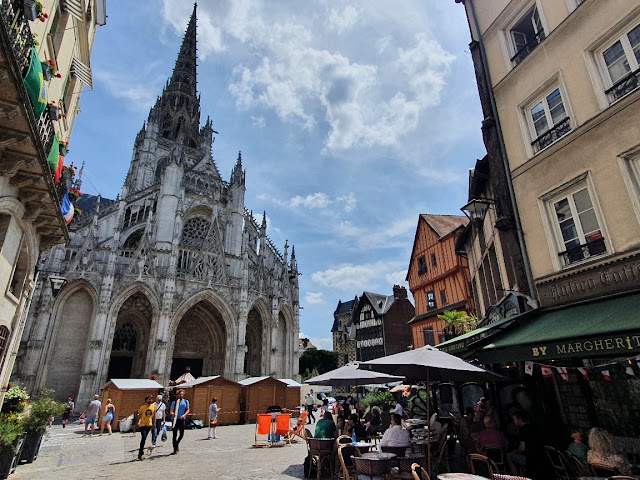

Rouen Cathedral

I crossed the River Seine via the Corneille Bridge and did a little amble along the river through a park, the Prairie Saint Sever, where people were having picnics or going for a jog. Returning to the station was straightforward. It was a case of crossing the Boieldieu Bridge and heading uphill. The station tower and clock was visible from a good kilometre away, so there was no difficulty in finding it. 


My mini stint around Rouen had been a very pleasant revelation. It seems like the local council has gone to town in its bid to be designated the European City of Culture for 2028, with various sevents taking place. I almost feel embarrassed to have not spent time there before now, given the numerous times I have passed through the station en route to Paris. I will make a point of spending a day here next time. 


Just when the station clock struck 2pm I was scuttling down to the platform to catch my Paris-bound train.

As much as I had enjoyed Rouen, I had a big smile on my face, knowing that I would soon be alighting at my favourite foreign city.


Related posts

Kit review: Testing out Alpkit bikepacking bags in Northern France and Flanders


Travel Notes - Normandy to Paris


2Wheel Chick goes to Paris 


Another year, another trip to Paris - Avenue Verte


Another year, another trip to Paris - Chantilly


Thursday, 1 September 2022

Freewheeling - Keeping away from cycling activists

As someone who is into cycling I have found that my love for the activity has slightly waned of late. It's not that I have gone off cycling. It's more to do with all that swirls around it. 

I have always had a fairly simple relationship with bike riding. I get on my bike, I ride. Sometimes it is for a leisure pootle, sometimes for training, or for racing. Other times it's just to get from A to B. I could be riding in London streets, on country roads, or along off-road trails. 

Normally, whichever sort of bike riding I do, I always enjoy it and find it a pleasant space away from the more humdrum activities of everyday life.

However, in recent times I have noticed that cycling has come very ...politicised. Whether it's folks going on about the safety/lack of safety on Britain's roads, sexism, racism, all other sorts of -isms, sustainability, clothing sizes for women, colours, sponsors of cycle races and teams, even bike brands. Whatever is happening in cycling it just seems to attract some sort of shouty reaction from certain quarters, all aired on Twitter - of course. It's all a bit much for me. 

I just want to ride my bike and not give it too much thought. Apparently, even that puts you at loggerheads with folks. Folks have been known to throw at me the accusatory phrase - "If you don't see a problem then you are part of the problem." I am supposedly meant to feel guilty about this.

Let me elaborate on a couple of things:


Race and cycling

Last year, I was asked by a cycling magazine to write an advertorial for a clothing brand. This would have involved interviewing two black women - one of whom has a large following on social media - and who has been vocal on racial matters in cycling. She set up a group known for women of colour who cycle. I don't particularly agree with such groups forming based purely on race. It is a view I am entitled to, though as a professional journalist my personal views do not influence the way I work. However, I was later informed by the editor of the cycling magazine that I was being removed from the job because the two black women asked not to be interviewed by me. Apparently they didn't approve of my views. 

The advertorial was going to be related to training to cycle 100km - nothing to do with a person's race, but yet I was removed from the job! So suddenly I became the subject of "cancel culture". Ironically, these are the same women who campaign saying "representation matters" and want visibility of black people in various roles, including journalism! Absolute hypocrisy. I must also add that in the 12 years I have been involved in journalism this is the only time an interviewee has asked to not be interviewed by me.

I first became involved in club cycling in 2000. At that time there were hardly any black people who took part in club cycling. There were a few; just not many. Nevertheless I found the cycling community to be very welcoming. Sure it was dominated by white males - maybe even middle-aged, middle class males. I didn't ask them their ages or their class, and even if I could have taken an educated guess, I couldn't really have cared one way or another. I was just interested in being in a friendly environment, and that's how I found the cycling milieu to be. 

Fast forward twenty years and everyone is talking about cycling being racist and that the lack of black people involved in cycling is because we were being excluded. No one ever stopped me from riding a bicycle or taking part in events. 

I am not saying that I don't believe other people who say that they had a negative experience, but I think it's important to realise that people have different experiences in the same situation. When I say that I have had a positive experience I don't see why folks should look at me negatively. It's almost as though I have committed some sort of sacrilege because I am not going out and mouthing off about breaking down barriers. 

In my time I have known many black people (including members of my own family) who are just not interested in cycling, and who even wonder why I do it! That's been my experience, and for me to believe that the lack of black people cycling was down to personal preference rather than racial bias was not an unreasonable conclusion to draw. Because of that, some see me as a pariah for not joining them in their crusade. One black guy who has made his name by hosting an exhibition about Black Cycling Champions and claiming that cycling is a racist sport even blocked me from his Twitter account!

It is interesting how some of these people campaign for inclusivity, but yet their behaviour, by its very nature, is to exclude those who don't share their opinions.  


Militant Cyclists 

I have ridden bicycles around since the 1970s. My time as a commuter cyclist in London began in 2001. Back then, there were make-shift cycle lanes - mainly a line painted along the edge of the road but you weren't separated from traffic at all. I remember the first time I cycled from my home in Crystal Palace all the way to my office at the time, which was in Marylebone, I rode ever so cautiously and was quite nervous. But in fact, it wasn't bad at all. I quite enjoyed the experience and I was happy to continue riding my bike through the London. I have commuted by bicycle ever since. 

Nowadays we have the luxury of segregated cycle superhighways and special cyclist traffic lights to get you across busy junctions. I think these are great additions and have been instrumental in encouraging more people to cycle in London. I think that London is now an even better place to cycle, and its facilities are now comparable to (if not better than) some other major cities around the world. I can confidently say this as I always make sure to ride a bicycle (either my own or a hire bike) whenever I travel abroad. So I have ridden bicycles in cities around Europe, North America, South America, and the Caribbean, in my time.

The thing is, whenever I look at Twitter I see angry messages from various people about how terrible it is to cycle around London. I just don't share that experience with others. Sadly, if you respond on this platform saying that you have had an enjoyable experience people lambast you saying you don't know what you're talking about and asking you to produce statistics.

Campaigning organisations also want to suggest that every other city in Europe has better cycling infrastructure than London. I would take them seriously if the protagonists actually regularly commuted in those countries. Many of them have never cycled abroad - or at least when they cycled abroad it was in a holiday resort within that country as opposed to a city where people get on with daily life. These are not even like for like comparisons, so folks then draw their conclusions based on photographs of cycle lanes in these cities! 

A recently constructed segregated cycle lane in central Paris, running along rue Saint Antoine from Bastille to Chatelet, and on to Rivoli and Concorde has received much praise on social media. Granted it is a very useful cycle lane. But is this segregated lane better than an equivalent one in London? And does it mean that every cycle lane in Paris is in the same style as the one on Rivoli? 

I get astounded by how people take this cycle lane and extrapolate saying the whole of Paris has cycle lanes like this, and life as a cyclist in Paris is much better than in London! Have these people never ridden the Cycle Superhighway from Elephant and Castle to Clerkenwell? Or the path from Tower Bridge through Westminster all the way to the Royal Albert Hall? What is the difference? In fact I would argue that the London segregated paths are better than those in Paris because they are completely closed to motorised traffic. Cycle lanes in Paris still allow space for delivery vans - and the van drivers make the most of that permission! You certainly have to be on your guard when riding in a bike lane.

Then of course there's the "we hate cars" brigade. Activists have even taken to deflating the tyres of SUVs under cover of darkness and leaving notes reprimanding them for owning one. Interestingly, these will be the same people protesting against the regimes of Vladimir Putin of Russia, Kim Jong-un of North Korea or Xi Jinping of China. But yet, these urban rebels feel that it's okay to disrupt the lives of people who don't embrace their beliefs and behaviours.

And let's not forget the countless cyclists who jump the red traffic lights - some with fatal consequences. Campaigners continue to lambast terrible drivers of motorised vehicles. If you dared to question cyclists who flout road traffic laws they give a response along the lines of cyclists don't kill people when they don't jump lights. Some even refuse to acknowledge that this law-breaking occurs.  

I don't understand how they can't see that this brand of self-righteousness, and thinking they are above all other road users just doesn't endear them to the general population. It's not surprising that folks make negative comments about these militants on pushbikes, and display negative behaviour towards them on the roads. Travelling around a town should be about sharing the thoroughfares, not occupying them to the exclusion of others.

And so, in the climate of what I have mentioned above, I find it quite difficult to call myself a cyclist. I get concerned that people may automatically picture me as one of those scary angry folks who jumps red lights and refuses to give way to any other road user. 

These days I prefer to consider myself as a person who likes to travel by bicycle, among other forms of transport. In addition, I like to do club cycling and cycle races, as well as other sporting activities. I think it's better to not let myself get too immersed in the chatter of activists and militants.

It's nice to see that more and more people are taking to push bikes. London has definitely become more of a cycling city, than ever before. Though I must say that I personally don't feel any push to say that everyone should ride bikes, though I wouldn't dissuade it either. And I certainly don't believe that anything in society is discouraging others from getting into bike riding if that's what they want to do.  

Above all, bike riding is always about choice. You make your choice and respect the choices of others. Sadly, I think that what I have said here sounds much too reasonable, and is likely to once again attract the ire of others.

Sunday, 31 July 2022

The Tour de France Femmes est arrivee!

The day finally came for the women's Tour de France, known as the Tour de France Femmes with Zwift. 

After years of campaigning Amaury Sports Organisation finally put on a women's stage race around France, that can become the race of reference for pro women. Also, given that it was happening at the time of the men's Tour de France the women's race had a high profile, media coverage, and hopefully a lot of public interest.


I had a media pass to attend stage 1, which started from the Eiffel Tower and consisted of 8 laps around central Paris, going along the same route that the men use during their customary finish in Paris at the end of the Tour de France each year.

The last time the women's pro peloton raced around the streets of Paris was during the first edition of La Course, 10 years ago. This race was the predecessor event to what ASO are now organising for the women's pro peloton. At the time the event took place first thing on the Sunday morning, with not much of an audience. Granted, the event was televised but then at that time of the morning there would have been a limited audience to see Marianne Vos cross the finish line and do her victory salute.

However, this event was a very different matter. This was the culmination of a lot of campaigning, negotiations and behind the scenes preparation. There had been a lot of publicity in the months running up to the event, and it had been the talk of the town among all cycling fans.

So the day had finally come, and this would be the first day of  a week-long Tour de France Femmes. Although described as a tour of France, the stages were going to be largely in the Alsace and Vosges, just in Eastern France.

On this hot sunny day in July I got on my bicycle and made my way from my lodgings in Vincennes to the press centre, just behind the Champs Elysees. It was my first time going to the press centre for the final day of the Tour de France (and the first day of the Tour de France Femmes) and the thing that struck me most was the number of road closures, even for bicycles.

It is understandable to have heavy security at such a grand scale event in central Paris, but recent unfortunate events such as terrorist attacks and the "gilets jaunes" rioters meant that police presence was omnipresent, complete with machine guns and even CRS (like the UK equivalent of the SAS). All this made it difficult, once I arrived at Concorde to get to the area just across the road from me. My trip involved a real tour of Paris. Then as if that wasn't enough there was a lot of haggling with the ASO staff to get through to the Media Centre. A few other journalists with me also encountered the same difficulties - an officious guy refusing pass down the small avenue to reach the media centre and folks angrily remonstrating. All that added about an hour to my journey and by the time I reached the media centre I was ready for a rest. There was no way I was going to venture across to the start line of the women's race at the Eiffel Tower, and preferred to stay where I was and watch them on the Champs Elysees, as well as on the TV in the media centre.

This was definitely a historic moment, with plenty of spectators watching the first stage in the afternoon sunshine in central Paris. There had been so much build-up to this day - with the various column inches having been written about the history of women's Tour de France races in the past, analysis of the route, pundits views on how will win, and that's before counting all the various initiatives by Zwift, Santini and other sponsors.

In the end, for me, when the big day came, the significance of this moment was forgotten - perhaps because of all the logistical hassle, perhaps not - and it was all about reporting on a women's cycle race and then dashing off to the media centre for the post-race press conference.

I know there were probably people who really were smitten by the occasion, and were quite emotional about it. I can't say why I didn't feel that way. I think that for me, the big moment came when there was the announcement of the race last year and the grand reveal of the route in Autumn in Paris. Thereafter, I wanted to just focus on the job in hand and the racing itself. There's a limit to how much you can say about a historical moment, and when it comes to sport, the engagement comes through exciting racing.

It was a fast-paced race with a couple of crashes during the 82km circuit race around the Champs Elysees, Concorde and Rivoli. Different women went off the front for a spot of limelight under the lenses of the world's media, but the main bunch with the protagonists largely stayed together. In the end the result was decided by a showdown between the most experienced racer, Marianne Vos, and her young compatriot Lorena Wiebes. The youthful pre-race favourite, Wiebes crossed the finish line on the most iconic of avenues and ended up on the podium in the yellow jersey. It would have been good to see Marianne Vos up there, but Wiebes was a very worthy winner. Marianne Vos (possibly the greatest racer of all time) did get to wear the Green Jersey at the end of the 8-stage race. Sadly, Lorena Wiebes, who went on to win a second stage, withdrew from the race on Stage 7 as a result of a crash the previous day. 

The other overall winner, Annemiek Van Vleuten did it in combattive style after having had setbacks during the early stages, including racing with an upset stomach and having stop on the roadside for a poo during the hilly stage to Epernay. On the final stage, with a commanding lead over her second-placed rival, Demi Vollering, Van Vleuten encountered mechanical problems and had to change bike twice. Yet she still found it in her to stay head of everyone on the legendary climb up the Superplanche des Belles Filles.

For me, that is sort of thing that excited me about the Tour de France Femmes. Women now have a stage race of reference. Rather than repeating the "wow women have a Tour de France", I want to move things on and say "Wow, wasn't that an exciting race." And I am glad to have been able to say that about this inaugural Tour de France Femmes.

Saturday, 20 November 2021

Cycle route: Eastern suburbs of Paris by bike (part 1)

Route Summary

Vincennes - River Marne trail to Chessy (Disneyland Paris) - Dampart - Claye-Souilly - Ourcq Canal towpath - Bassin de La Villette (Paris) - Vincennes

Distance: 78km   Climbing: 250m

Route on Strava


Route in detail

Whenever I go to Paris I take my bike. I either cycle all the way there including a ferry crossing in Dieppe. Or, of late I get the train all the way there. If you do the Dover-Calais crossing you can get a regional train from Calais Ville station or a much faster (and more expensive) TGV from Calais Frethun station to Paris Gare du Nord. 

Arriving in Paris from Calais by TGV

Being in Crystal Palace I prefer to go to East Croydon, get to Newhaven, take the ferry to Dieppe, and a regional train to Paris Gare Saint Lazare from there (with a change at Rouen).

Once in Paris I use my bike to get around the city. I also use ot for longish bike rides into the outer suburbs and towns. 

In the past, I have been West to places like Versailles and Rambouillet. I have also been South, to Fontainebleau. 

Although I tend to stay on the East side of Paris when I visit, I haven't tended to go much further than Vincennes. 

So on my recent visit there, in October, I cycled out to the Val de Marne and Seine et Marne departments (counties), which are named after the River Marne, the main river in the area, and is a tributary of the River Seine. I headed out towards Chessy, close to Disneyland Paris.

The thing about this ride is that it was largely traffic-free as it involved cycling along a river (the Marne), and then later on, a canal (the Ourq).

Bois de Vincennes

My ride began from Vincennes, where I was staying. I headed through the woods along a gravel path behind the Parc Floral, passed the lovely Lac des Minimes and left the woods to go through the suburb of Nogent sur Marne, and joined the traffic. 

There were a couple of segregated cycle lanes, but they weren't on all the roads - and not on the roads I needed to get to. But I didn't feel unsafe, particularly as the traffic was very slow-moving due to road works (plus ça change!). 

The noteworthy thing was how the road climbed steeply - something I hadn't been expecting - and then it dropped down really fast to reach another suburb, Le Perreux sur Marne, which was right on the river. The area looked pretty upmarket (or BCBG, as the French would say). Folks often talk a out "La banlieue" (the suburbs) with negative connotations, evoking images of high-rise council flats and neighbourhoods awash with deprivation, crime and the odd riot. I have certainly seen suburbs like that, but I have also seen many suburbs that definitely showcase how the other half live.

River Marne at Le Perreux

Le Perreux, with its beautiful houses bordered by picket fences overlooking the River and with Mercedes SUVs parked outside was clearly in the latter category.

Crossing the river via the footbridge to Bry sur Marne was a good opportunity to make the most of the sunshine on this beautiful autumn day and take some photos. 

Given how peaceful this suburb was, I could even get some clean photos with few people around to photobomb the images.

A few joggers and walkers passed by, but that was not a problem. One couple were curious and asked if I was making a film. Funnily enough ough they washed me good luck in getting descent photos ad it was "really busy on this bridge, with so many people"! They obviously don't get out to Pont Neuf or Pont des Arts in the big smoke of Paris much at all.

Footbridge to Bry sur Marne

Onwards I pressed, along the left bank of the river, to reach Noisy Le Grand.

 This ride felt like a tribute to the RER A suburban train line as all the place names were stops I'd seen on the RATP transport map of Paris. Indeed, the train line criss-crossed my route at various points. 

By this time, the neat houses were behind me, and I got a glimpse of the slightly rough and ready landscape of an area that was distinctly downmarket. 


(Continued in the next post)


Related posts

Cycle route: Eastern suburbs of Paris by bike (part 2)

London Waterways ride - Thames path and Wey Navigation

London Waterways ride - River Cray and River Lee

Navigli of Milan and Suburban bike ride

Tuesday, 9 November 2021

Rouleur Live - London rocks! Why I think London cycling infrastructure is pretty good

It was a pleasure to be on the panel at the London Rocks presentation at Rouleur Live, to talk about the positive aspects of cycling and cycle culture in London.

So many people talk about cycling in London in a negative way. It's something I have never really joined in doing, because I simply don't feel that way. I really enjoy cycling around London.

Rouleur Live panel, L-R: Laura Laker, Alec Briggs, yours truly, Ned Boulting

As someone who likes to travel by bicycle around London and in all the other places I visit around the UK and beyond, I don't think London does too badly, all things considered.

When Ian Cleverly of Rouleur asked me about appearing on this panel I was quite excited about doing it. In fact, I even put together a flow of how I thought the presentation could go! 

But a basic brief had already been put together and other panellists confirmed, so it was a case of going with the flow on the day. The presentation was chaired by Rebecca Charlton, and the other panellists were Laura Laker, Alec Briggs, and Ned Boulting. We all had slightly different perspectives: Laura was occupying her role as the active transport guru, given the writing that she does about it in The Guardian, Alec is a bike racer, though not a nerdy one that only talks about bikes and tech - but more of a cool hip kind of guy who keeps it real. The fact that he can also win races is just coincidental! 

Ned was there in his capacity as social commentator given that he gets on the telly a lot, commentating on the Tour de France, and other major cycling competitions, as well as being an author and a president of Herne Hill Velodrome. Then there was me - in the brief I was just billed as "all round good egg who likes to get out there rather than just talking about it!" I'm cool with that description.

We all had something to say, and were very positive about bike riding in London. The audience which engaged with us too, which is always a bonus. The main points we had to say is that London gets a bad rap, which is slightly unfair given that it is a newcomer in terms of infrastructure compared with other cities like Amsterdam and Copenhagen. 

Also, people have a tendency to take to social media to rant about negative aspects of cycling. Folks generally aren't going to go on-line to tell positive stories. It's not helped either by certain high-profile folks in media who constantly post footage from their helmet cameras about something they saw that didn't go well. 

There needs to be a way of highlighting the positives of cycling on a regular basis, rather than painting cycling in London as a doom and gloom picture as though folks cycling on the road were entering a lion's den or playing Russian Roulette.

In terms of cycling culture, because London is such a diverse place, there are varying "cycling tribes", meaning that some sets of cyclists don't always warm to other types of cyclists - for instance those dressed in Lycra on their road racing bikes vs. those in everyday clothes on a hybrid bike. 

At this moment in time, London is trying to find its feet in terms of cycling culture and cycling infrastructure. At some point things will settle down and cycling will become normalised as an everyday thing, rather than it being a specific activity set apart from other everyday activities. 

For the presentation I noted down various points, though didn't have the time to mention everything, so I will note them here:

  • I first started cycling around London in 2001, at a time when most people cycling were cycle couriers and only a few hundred cycle commuters. I would only see about one or two women per week on a bike.
  • There were no segregated cycle lanes at all - just the odd road that had a painting of a bicycle on the edge of the road, marking the bike lane! I used to spend time planning my own route from A to B through London via various back streets as there were no sign posts or maps. 
  • Junctions at Elephant & Castle, Old Street, and Vauxhall Cross often involved putting my observation and bike handling skills fully to the test! 
  • Nowadays, we have segregated cycle lanes including at those aforementioned busy junctions, a Superhighway network, signposted Quiet Ways, traffic-free paths, and a bike-sharing scheme for those who don't own a bike.
  • When cycling to work at rush hour, there are so many cyclists on some roads that it's almost like being part of a mass participation bike ride. 
Segregated (ish) cycle path near rue de Rivoli, Paris
  • Over the last 15 years that I have cycled in Paris I have noticed a steady growth in the number of cycle lanes, and on my most recent trip there had been radical changes, notably right in the centre, around Chatelet and Rivoli. 
  • However, the lanes aren't any better than what can be found in London, particularly because sometimes a segregated lane "disappears" and then you are back in with the main flow of traffic.
  • Segregated cycle lanes aren't totally segregated because there are gaps in the lanes to allow for delivery vans to pull into them!
  • The traffic lights are phased so that even if you have right of way in the cycle lane, motorists can still turn right across your path - so you have to keep an eye out. That is something that you see in many European cities. I also saw that when I cycled across New York City.
  •  It's great that many streets allow for cyclists to ride in contraflow up a one-way street, but some of the roads are very narrow, forcing you to give way to an oncoming van. 
  • Some of the roads in central Paris are cobbled - not quite Paris-Roubaix, but you definitely get a bumpy ride. Ditto for when I used to cycle around Milan.
  • There are very few green spaces to ride a bicycle in Central Paris until you get to the extremities of the city at Bois de Vincennes or Bois de Boulogne.
Bois de Vincennes on the edge of Paris - one of the few green spaces for bikes in the city
  • I cycled around Brussels a couple of years ago, and had similar experiences to Paris, in terms of motorists encroaching into the segregated cycle lane. Also, some parts of the cycle lane contained a drainage channel, which I found hazardous to cycle on, so I ended up riding wide and on the main carriageway.
  • Outside of Brussels, when riding in the Flanders region it was great to see cycle lanes on the A roads - something you also see in France as well.
  • Interestingly folks talk about Belgium, the Netherlands, Denmark, and other countries in Europe being more cycling friendly countries than the UK. During the first coronavirus lockdown I used part of the time to do conversation exchanges with folks in other countries (to practice my language skills). Whenever I asked them about cycling in their country (apart from the Netherlands and Denmark), they all said that they don't ride because they find cycling in their country dangerous!
  • Many cycling activists talk about wanting the freedom to ride their bike how they want - the freedom to wear whatever colour clothing they want, use or not use the cycle lane, wear a helmet or not, or put a bell on their bike.
  • In these countries that are deemed "cycling friendly" even they have their rules. In many countries it is a legal requirement for your bike to have a bell fitted that can be heard from 100m away; it is illegal to ride on the main carriageway where there is a cycle lane; notably in France, cyclists have to wear high-vis on dim days or at night when outside of the city; in Spain it is illegal to not wear a helmet when outside of a built-up area.
So in light of all of the above it is hard to say that cyclists in London get a raw deal compared with other places. In fact, I feel very happy to ride around London and have the liberty to wear what I want and not have to stress about finding a bell for my bike!

It is also worth noting that when comparing infrastructure to other cities around the world, London is a sprawling mass compared with other cities and that the Mayor of London has to work on a surface area that is easily two or three times that of other European cities. 

On Blackfriars Bridge, London, next to a cycle Superhighway

Furthermore, this surface area is divided into 33 boroughs, each with its own administration and decision making power regarding cycling infrastructure - an added layer that Sadiq Khan has to deal with when trying to improve cycling in the city.

So on balance, I don't think we do so bad, and I do agree that London rocks!


Related posts

South London to Central London by bike (mainly traffic-free)

London gears up for more bike riders

Friday, 15 October 2021

Excitement at the reborn Women's Tour de France - it doesn't need to be three weeks long!

At Palais des Congrès, Paris
Yesterday I attended the presentation of the 2022 Tour de France, at the Palais des Congrés at Porte Maillot, Paris. 

It's a pretty big affair with the auditorium being packed out with a couple of thousand people - among them, team riders, sponsors, dignitaries, community cycling groups, and journalists. 

This event always garners excitement - finding out what novelties there will be in the route, but the really noteworthy thing was the unveiling of the route of the inaugural Women's Tour de France. 

Yes, a women's version of the men's 108-year old event will take place next year. As the men finish their race on Champs Elysees on 24th July, the women will begin their event shortly afterwards at the Eiffel Tower.

The race will then consist eight stages, all in the North Eastern part of France, and will have use the infrastructure of the men's event organised by Amaury Sports Organisation, as well as being televised.

After the 82km-race around central Paris, the remaining stages will be around 130km, passing through towns like Meaux, Epernay, Troyes, Bar-le-Duc, with a 175km-stage to Saint Die Des Vosges and finish on the really challenging Superplanche des Belles Filles. 

Auditorium filling up at Palais des Congrès

Although they will only be racing for eight days, the women will have some pretty tough stages. A couple of stages will include steep gravel roads, and a couple of stages will go over the Grande Ballon, the Petit Ballon, and the Ballon d'Alsace - some infamously steep hills in the Vosges regions. 

The stage race will see an exciting end as women have to race up the 20%+ gradients of the Superplanche des Belles Filles, and sprint to the finish line along a 1km uphill stretch of gravel road.

These stages do look exciting, and it will be great to see them getting the scheduled two-hours' TV coverage that was announced, as women contesting for a share of the 250,000-euro (£210k) prize fund.

This is not the first time an ASO-organised women's Tour de France is taking place. This event took place between 1984 and 1989, with the winning woman being pictured on the podium alongside the winning man. The women did not win any prize money, and the event was not televised (though there was print media coverage). However, the event was not financially viable and was difficult to manage logistically.

Much campaigning has been done for a women's ASO-organised event that would get the same coverage, and be on par with the men's event. Since 2014, a one-day race, La Course has taken place during the Tour de France, on the route of one stage of the Tour de France, and that was televised. However, activists were quite dissatisfied with the event and saw it as a token gesture.

When this women's route was revealed, the audience response was positive, with spontaneous applause. The professional women racers I spoke to - Audrey Cordon-Ragot, Cecilie Uttrup Ludwig, Elisa Balsamo, and Evita Muzic - for Cycling News, were glad to have Tour de France and saw the route as correct, and in line with their expectations.

Tour de France Femmes with Zwift 2022 route

Some observers have bemoaned the fact that this so-called Tour of France is only concentrated within one region within Northern France, and is only eight stages long. But it has to be understood that a) women's road racing teams are smaller than men's teams (~13 riders vs. 30 respectively) and so there is less rotation of riders in races. Riders end up doing different types of races back-to-back, where men's teams operate a double roster. So a women's team doesn't have enough riders to compete in three-week stage races; 

b) there are a few stage races taking place within a short time frame - the Women's Tour of Italy, the Women's Tour, and another new stage race in Scandinavia (Battle of the North), so rider well-being needs to be kept in mind when setting out the number of stages in a race (as well as following the UCI rules on the length of races); c) over an eight-stage race it would be impractical to move the whole peloton across large geographic areas of France within an eight-day time frame.

In the last nine years that I have interviewed professional women, I have never met anyone who said they wanted to do a three-week stage race with 200km stages. It seems that these calls have been from activists who are calling out for their ideals of what equality means, independently of what current professional women's peloton actually want.

So I would rather take my lead from the feedback of the professional women racers. For them, the rebirth of a women's Tour de France is a very positive thing, and so I am inclined to agree with that. Of course, there are a few outstanding elements like a lack of a time trial stage. 

Also, the prize money, though significantly higher than other women's races is still a long way behind the 2.3M-euro (£1.9M) fund set aside for the men's Tour de France. This is something that can only really be addressed over time as media organisations gain confidence in televising women's cycle races and viewer numbers increase.

What has been announced is a good start, and I look forward to seeing the race play out next year. As Tour Director Christian Prudhomme says, I like to see it as something that will still be going in 100 year's time.

[I also wrote about the Tour de France reveal for The Times. Link here.]

Monday, 13 September 2021

Photo of the day - 13: Gigging with my band at Eastbourne bandstand


Ready to play with my concert band at Eastbourne

As well as sport, I do like a bit of music - making music...or something resembling that, if you ask my neighbour! I have had a clarinet for many years. It all started about 30 years ago when I went to live in France after graduating from university. In those early, cold, nights in Paris I needed to find something to do, given that I didn't know many people, and I would feel too tired to understand everything on television. So I hit upon the idea of filling my evenings by learning the clarinet. My neighbours were incredibly accommodating! I managed to get hold of a clarinet after one of the local music shops referred me to a guy in Montmartre who specialised in refurbishing second hand woodwind instruments.

So I made the trip across Paris and they guy sold me a Noblet for 2,000 Francs, which I paid for in instalments. They were very helpful and referred me to a teacher whose studio was above a sex toys shop. It was a bit seedy getting out of the Metro at Pigalle, passing the risqué looking men and women, and going up the steps to his practice room. But Didier's classes were fun. He said he was a bit nervous when giving lessons, and needed to smoke throughout, if I didn't mind. I kind of did mind, but I put up with it because his lessons were cheap. His main instrument was the bass saxophone and I went to see him play at jazz places in the 6th arrondissement of Paris on a few occasions. I was impressed that he had the breath to get out such long notes.

And that was the beginning of my relationship with the clarinet. I played regularly for about four or five years, including when I returned to London. But then it just tailed off as I got involved in other activities. Fast forward to last year when we had the near total lockdown in the Spring. Wanting to do something different during those incredibly unusual times, the clarinet came to the fore.

I have been enjoying playing - working through my grades, going to lessons, and I also joined my local concert band. I must say, playing the clarinet gives me a great feeling - something different from doing sport. It's quite a nice break from all the other energetic things I do, and there's a real feeling of satisfaction when you can produce a good tune either alone or with the band. I also like the versatility of the clarinet. You can do very low notes and very high notes (well once you get over the horrible squeaking). And it lends itself well to all genres of music - jazz, classical, folk, salsa/afrobeat, and just bog-standard pop songs too.

I did my first gig with the band yesterday. It was their first performance since 2019, and everyone was so pleased to be back playing to an audience after the coronavirus hiatus. We were at the historic Eastbourne bandstand for a traditional afternoon concert. It was really enjoyable, and it seemed that the audience got into it too. I could get used to doing more of these. The good thing for me is that today, at the band AGM I took up the role of Gigs Manager. I really fancy the idea of being involved in organising events - something I have taken great pleasure in in the past. So I look forward to us playing in more bandstands, a few church halls, bars, and who knows maybe - the Royal Albert Hall!