Sunday, 18 December 2022

The Monkey Motorbike Diaries - Episode 3

I am two-thirds of the way along the route to taking the L-plates off my dear Honda Monkey 125cc bikje. Part 1 of three was all about doing the theory test, and Part 2 was Module 1. The final part, Module 2, will be at a time in the not-distant future.

Slightly worn but somewhat valuable certificates!

Once I pass that then I will have the A1 licence. It is basically a full licence, but restricted to 125cc motorcycles. Usually the A1 licence is what young riders get as they are not old enough to be issued with the A licence which allows you to ride any sized bike. For that, you have to be over 21 years if you have done a progressive access course, or over 24 years old if you are getting directly into motorcycling. 

So, as a woman in her fifties some might say that I should go for the A licence. Folks on motorcycle social media groups often say that the A1 licence is a waste of time getting if you are over 24 years old. After all, it will cost the same to obtain as the A1 licence. Furthermore, you'd soon get fed up with riding a 125cc and I will be wishing for a big bike.

The thing is, on a number of fronts I don't agree with what folks say. Firstly, in my opinion, getting the A1 is a hell of a lot cheaper than getting the A license.

The motorcycle test to get the A license has to be done a minimum 600cc engine size. So given that CBT only allows you to ride a 125cc then any time you want to practice and prepare for the test you have to go via a motorcycle training school. The A1 licence, being for 125cc bikes means that if you own a 125cc bike you can prepare for the test yourself, without having to go through the programme in a training school. And it is true that the sessions will be the same as for the A licence so it will cost almost the same - around £800-£1000.

So yes, there is a case for going for the full A licence if you only plan to prepare via a school. But that's not my line. I went to two different schools in order to obtain my Compulsory Basic Training (CBT) certificate, neither of which were schools that I rated. By the time I'd done my CBT I had had my fill of training schools and so am not ready to send my cash to any training school for the time being.

So with that in mind, I was ready to do the A1 as a privateer and just pay the test fees (£15.50 for Module 1, £75 for Module 2) plus a small investment (£15) in a set of cones to practice riding around in a car park.

As I already have my little Monkey to ride I can get all the practice I need riding around the various streets in London. For my Mod 1, I took to hanging out in carparks - at the local Tesco, usually early in the morning; then in a local sports centre, and even just on quiet residential roads for things like the emergency stop and hazard avoidance test. 

When I told a few people of my intention to prepare and take the test as an individual many people were quite skeptical of the idea and told me that it would be really tough as I don't know what the examiner will be looking for - there is a reason why people get trained by a motorcycle instructor. I just didn't feel convinced that a motorcycle instructor would teach me anything that I couldn't work out myself or obtain from online resources. Judging by the behaviour of other instructors I had experienced I just didn't rate them enough for me to want to take any instruction from them.

After passing the multiple choice test, which I thankfully passed first time, with the help of the DVSA video practice tests in books and on-line, I then attempted my Mod 1 at the driving test centre in Mitcham. That wasn't a great experience.

I had visited the test centre a couple of days before, to get a feel for the layout of the place, but I wasn't allowed to ride around the route. On test day I was very nervous, and the examiner was anything but friendly or welcoming. He delivered the instructions quite quickly and when I asked him to repeat, so that I could check I had understood what he wanted, he sighed and repeated them again just as quickly. At one point he said, "You haven't had no lessons have you?" I replied that I had prepared for the test but I was feeling very nervous. That didn't register with him and when I asked him to repeat the instruction on another occasion he shouted at me saying, "You should listen."

Despite all that I performed all the tasks correctly, except for the very last task, the hazard avoidance. On my first go, as I looked at my speedometer and saw 25 mph shortly before the speed trap I abandoned the attempt knowing that I wouldn't be able to reach the required 31mph.

On my second attempt I was determined to give it some welly, revving the engine right up and I went through the trap at 34mph, then brought the motorbike to a controlled stop feeling pleased that I had done a good swerve.

But, uh oh! I looked at where I had parked the bike and realised I stopped completely in the wrong place, and nowhere near the cones where I was required to come to a halt! I knew I had blown it and just wanted to ride straight home.

The examiner said I hadn't done badly apart from the final exercise, and he put it down to me having gone through the speed trap too fast, and not being in control of the bike. I didn't agree with that. I knew that the nerves had gotten the better of me, and his behaviour had not helped matters.

I went home feeling quite furious with the situation and fed back about the behaviour of the examiner, who I later discovered had not even gone through the proper administrative processes at the start of the test. I have no idea if DVSA will have taken any action in respect of this. Given some of the negative feedback that I have heard about the place, I don't get the impression they care.

On the road to a life of no L-plates

Still, it didn't stop me going back to take the test on another occasion. On my second attempt I did everything perfectly, but once again I failed on the hazard avoidance test. My first attempt was too slow, and on my second attempt I looked down at the speedometer, and seeing that I was at 34mph I thought "great" and released the throttle, only to drop, unbeknown to me, down to 28mph. I could have kicked myself. Finally, I got the test on my third attempt, and with just one minor error. When I did that test, I didn't feel nervous at all - probably more fed up and with a bit of a ground hog day/here we go again feeling. So I was probably quite relaxed!

It's been a bit of a faff getting the Mod 1, but to be honest, I still feel that it has been worthwhile doing it this way, and I have generally been very much in control of where I am and how I go about the motorcycle test preparation. The times I failed were on the same issue - the hazard avoidance test. That was also the aspect I practiced the least during my preparation because it wasn't that easy to find an off-road space where I could ride at 31mph without potentially being a nuisance. But when I found a magic cul-de-sac the day before the test, and practiced on it during a quiet time of the day that made all the difference. I now have the final part to do - hopefully that will be a more straight forward affair. 

Some people might still wonder why it's so important to have an A1 licence if I could just continue with the CBT certificate and L-plates, then keep renewing it every two years - something that is quite commonly done. Firstly, I am not sure how economical that is in the long run because CBT renewals cost at least £150 (as much as £180) in the London area, and that works out as as more than taking an A1 test. 

Once you have an A1 licence there is no obligation to renew anything, You don't need L-plates and you have the same status as anyone on a larger bike. So you can carry a passenger (if your bike is set up for that), you can ride on a motorway (if you dare to do so on a 125cc bike), but for me most importantly, I can take the bike abroad. My goal in the next few months is to be able to take the Monkey to France - to ride up the Champs Elysées, park there and soak in the Paris in the Spring atmosphere. I look forward to getting to the French capital significantly quicker than on my pushbike!


Related posts

Monkey Motorbike Diaries - Episode 1

Monkey Motorbike Diaries - Episode 2

Tuesday, 6 December 2022

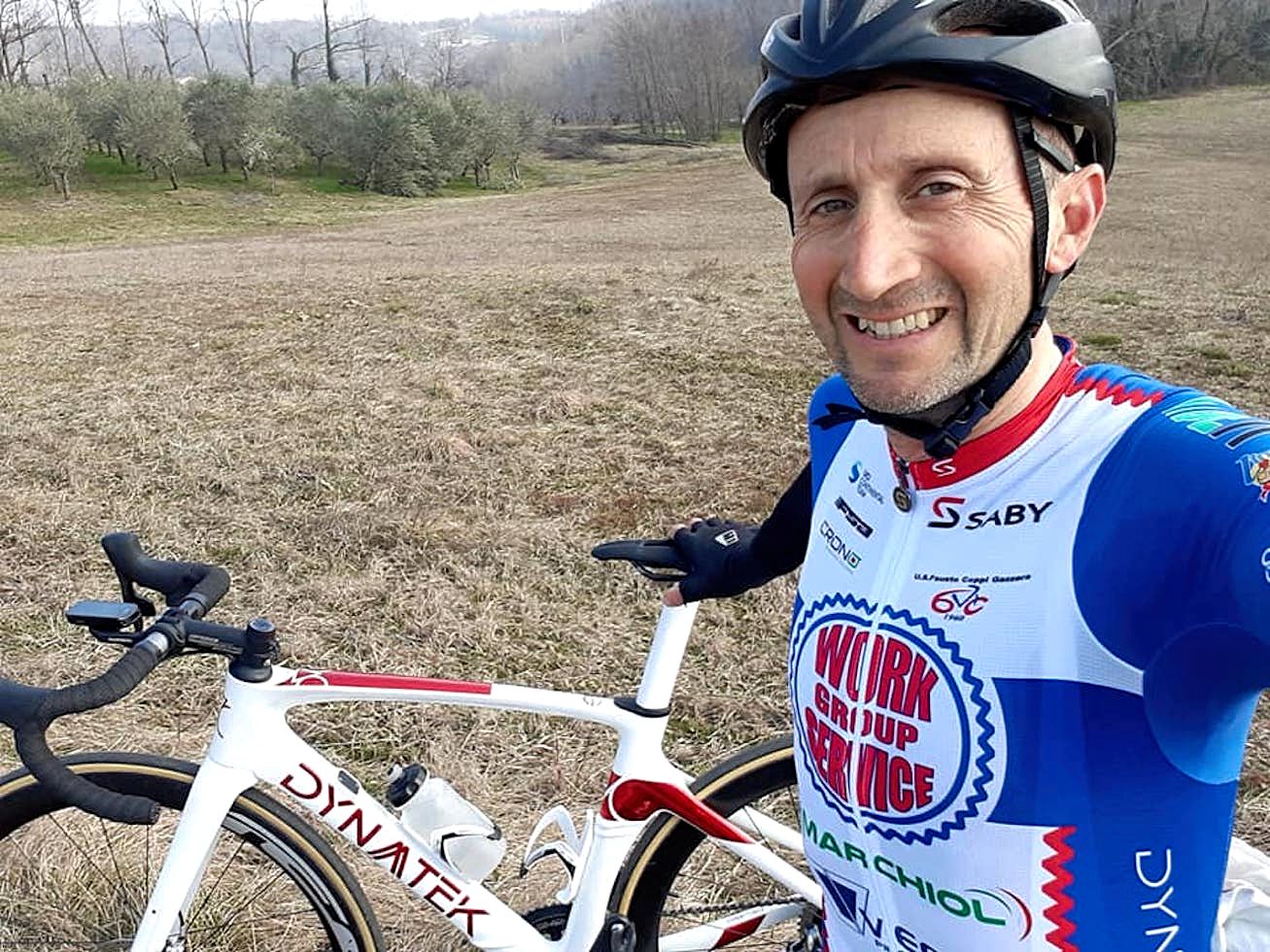
Freewheeling - The senseless killing of a cycling champion: Davide Rebellin

Italian ex-professional cycle racer Davide Rebellin was knocked down and killed by a heavy goods vehicle while on a bike ride last Wednesday morning (30th November). 


The accident occurred on a roundabout on a road he had cycled on literally millions of times, for it was just four miles from his home in Lonigo, near Vicenza. 51-year old Davide was born and bred in this area, and had ridden around these roads since the time his father Gedeon, who owned the local grocers shop and was cycling fanatic, got him and his brothers into cycling when he was 10 years old.

Carlo, Stefano and Simone liked cycling, but it was Davide who had a real gift for spinning the pedals fast, winning world junior titles and national races. At the age of 20 he got the call-up to represent  his country at the Barcelona Olympics, where he was instrumental in securing a gold medal for team-mate Fabio Casartelli (who died three years later in a horrific crash during the Tour de France).

A young Davide (right) with his brothers
[Credit: Rebellin family] 
Davide turned professional immediately after the 1992 Olympic Games and raced for different teams throughout his 30-year career including Gerolsteiner, Polti and Francais des Jeux. A specialist of the Spring Classics, races that take place in March and April on testing, undulating  sometimes cobbled  windswept roads in Northern France, Belgium and the Netherlands, Davide made his mark in 2004 by becoming the first rider to win Amstel Gold Race, La Flèche-Wallone, and Liège-Bastogne-Liege - the Ardennes Classics Week series. 

Over his 30-year career, he took 62 victories, including a victoria at the Giro d'Italia and a silver medal at the Beijing Olympics. The medal was revoked following a positive drug test, but he was then absolved of the charges following a 7-year legal battle.

Davide finally ended his professional cycling career on October 16th this year, where he took part in a race in Verona, in his home region. 

The quiet-mannered man who lived for cycling, was looking forward to spending more time with his friends and family between Monaco and Veneto, in this next phase of his life. 

But barely six weeks into this new era, on a morning in which Carlo was originally going to join him on a training ride (but was unable to go when something coming up at work) Davide cycled out, never to be seen alive again.

An articulated freight truck registered to Rieke Transport, a family company based in Recke, in the Rhine-Westphalia region of Germany, sped round a roundabout near the Montebello interchange between the Venice-Verona A4 motorway and the regional Stradale 11 road near Vicentino. In the process Davide was hit in the blindspot of the vehicle, trapped and dragged for around 25 metres along the road. Davide died instantly. 

These tragic events bear echoes of another shock to the world of cycling, in 2017 when Michele Scarponi, a racer, preparing to contest the win at the Giro d'Italia (Tour of Italy) was killed in a road traffic accident near his home. 

Where Scarponi was hit by a transit van whose driver stopped at the scene and was charged (though later died of cancer) the Rebellin incident had a shocking twist. 

The driver of the articulated lorry, a 62-year old Wolfgang Riecke, fled the scene. The man stopped, briefly looked at the scene of the accident, then jumped back in the cabin and fled back to Germany. Unsurprisingly, the social media pages for the freight company has been flooded with angry comments and insults.

Aftermath of the fatal accident [Credit: ANSA]

Although Italian police are due to charge the German national with road traffic homicide, at present they can't arrest him because this charge is not classed as a crime in Germany, and so no extradition can take place. 

The sight of Davide's road bike all crumpled up and in pieces, gives chilling thoughts about what happened to the cyclist in those final fatal moments. Coupling that with the notion that the perpetrator could practically get away with murder is sickening. Note that the driver has antecedents, having pleaded guilty in 2001 of leaving the scene of a road traffic accident he caused while driving, and having his driving licence temporarily revoked in 2014 for drunk driving. I hope that justice is done for the Rebellin family.

In the mean-time an autopsy is due to take place on 13th December, and the funeral will take place soon after that, in the cathedral of Davide's home town in Lonigo. 

May Davide rest in peace.   

Monday, 14 November 2022

The Struggle is real - especially in the Lake District!

It has been announced that next year's National Hill Climb Championship will take place on The Struggle in the Lake District. Even the name of this climb brings fear, unlike this year's event which took place on The Old Shoe, in mid-Wales. That name sounds like that there's something particular about the hill, but not necessarily anything to be afraid of. Mind you, in my case as a non-climber, once there I would probably freak out anyway!


I didn't get to ride that particular climb, and I didn't feel I could prepare myself for those championships due to time constraints. The year before that the National Hill Climb Championships were contested on the leg-busting Winnats Pass, in the Peak District. That is a climb I know well, but I still didn't do as my previous attempts had been pitiful and I knew I'd be an embarrassment on the day. Watching the riders battle up it on the big day in biblical conditions confirmed that I had made the right decision to not sign up for it. I would most certainly have got wheelspin and keeled over within 10 metres of the start line!

Funnily enough, despite the scary name of the climb for next year's National Hill Climb Championship I am tempted to give it go. I cycled up The Struggle earlier this year, and although I wasn't particularly quick, I got through it without feeling the need to stop or put my foot to the ground. That's already a result on those demanding roads in the Lake District.

Before I sign my legs away and launch myself into the preparation I must take the time to reflect on what it was like riding up this challenging alternative route to the more gradual and gentler Kirkstone Pass. Here is my recollection from earlier this year.

In the centre of Ambleside I took North Road, next to the Post Office. It's a small turning on the left that can easily be missed as you are swept along in the tourist traffic going around the one-way system en route from Grasmere and Keswick. 

Immediately, I was on a short narrow uphill road. Gosh, is this it already? I thought. We were officially still in the town of Ambleside so surely it can't have been the climb. Surely The Struggle goes through countryside, right? At this point I was actually on Kirkstone Road away from the hustle and bustle of the high street, but still very much in the town.

As the road reached a T-junction it became clear that the infamous climb was still a little way off even if the general trend locally was for all roads to be going upwards. The roads aren't always really steep. You get lots of false flats going uphill. In any case, it was important to have low gears on your bike whenever you ride in these parts.

From the T-junction I turned right, going behind the stone buildings that housed various shops, cafés and hotels. The road climbed gently and the area became more residential as the village centre had been properly left behind. 

Wansfell viewed from The Struggle with Kirkstone Pass in the distance
I met with a few cars coming down the hill, and they gave way to me on the slightly narrow road. They seemed to give that knowing smile, that said, "I know what you're here for....and boy are you in for a treat"!

The mountain passes of the Lake District are very well known. The local pass, Kirkstone Pass is known for its spectacular vistas across the open valley as you go up to the summit, site of the pub by the same name.

Among club cyclists, real bragging rights are earned by taking this back route to the Kirkstone Inn - The Struggle. So any self-respecting cyclist on a visit to the Lake District has got to try, if only once, the Hardknott-Wrynose duo, maybe Honister Pass too, and definitely The Struggle given its proximity to Ambleside, the most popular zone of the Lake District national park. 

Thus, local residents are accustomed to seeing streams of fit-looking cyclists on lean mean machines on their quest to conquer The Struggle. These Lycra louts form part of the wallpaper in this locality.

Eventually I found the start of the climb, indicated by a signboard with its name and a clear warning.

I felt slightly nervous at this point, and felt this was the time to stop, make sure everything on my bike was properly adjusted, including being in a more than suitably low gear, making sure my front water bottle was replenished, and I stripped off any excess clothing.

I also calmed my nerves, telling myself, "It will only be a mile or so of uphill riding, I do have the legs - but if I don't, it will be less than a mile of walking!"

So I started the climb, with a certain amount of trepidation. The opening metres of the ramp increased in steepness abruptly as I cycled passed some cottages. Given that the windows were close to the road and gave occupants a clear view of riders on the hill, I made an effort to try and look elegant - which meant going along at a slow but steady pace. 

False summit on The Struggle
As the road curved around to the left it ramped up again, probably to around 20%. I could feel the real work was beginning now. Furthermore, on this blind corner I needed to have a bit of physiological reserve in case I met a van when rounding the corner. So I dropped my pace, while still keeping enough cadence to not keel over. This became a real grind as I had to just focus and tell myself - "this will pass". Not knowing what would be around the corner, I mentally prepared myself for another ramp. And sure enough, there was - this time going to the right. By this time there were no houses, so I no longer needed to worry about spectators! As the road snaked left and right, the number of trees as well as the houses thinned out and the valley came into view. 

It has to be said, the landscape was spectacular. It was amazing to see a bowl to my right with lots of valleys and Wainwrights around Wansfell, and then the main road, the official Kirkstone Pass just behind it. Eventually I reached what I believed to be the summit and quietly celebrated the fact that I had conquered this beast.

Finally arrived at the Kirkstone Inn
In the area were a few people who had parked up to contemplate the viewpoint, as well as walkers. I got chatting to some local people who were impressed that I had managed to get up the hill. Reassuringly one of the woman, who herself is a cyclist told me that if I could get up The Struggle I would be fine to get around the Fred Whitton route. "Nothing on the Fred Whitton course is harder than The Struggle", she affirmed. I'm not sure if I should have believed her, but it sounded good.   

Onwards, I pressed, looking forward to the descent that immediately followed. the road twisted and turned a little as it wound around more hills and over little streams. This place is well worth a visit even without a bike. You just need to be comfortable driving up the steep narrow lanes and be able to keep calm if you need to give way to an oncoming vehicle, including an adventurous campervan!

Well, there I was thinking that the steep hills were behind me as the Kirkstone Inn came into view. In fact, they weren't. About one kilometre before the end of the road, my legs had a rude awakening as the road ramped up again. It was a real strain to get my legs back into gear to push my body over the last mound, and the final bend. 

Reaching the main road, the end of the climb provided a very painful sting in the tail to the point that it almost reduced me to throwing in the towel and walking. The gradient of this section must have been more than 20%. 

In a way I'm glad I did continue to pedal because at that point I heard the sound of cars driving by on the main road, denoting that I was practically at the junction and the Kirkstone Inn, the definitive finish line. Ah, my challenge was finally over and I had managed to ride the whole thing without walking. What a relief to have completed it. And what better way to end the climb than with a pub right at the finish line.


So that is The Struggle in a nutshell. I know I can ride it, meaning that I could prepare for the National Hill Climb Championships. All I need to do is to just work on going a bit quicker - simples. Err, now that may well be a struggle!


Related posts


Thursday, 3 November 2022

Tackling Fred Whitton light (aka Lion and Lamb Challenge)

I have received an email reminding me that entries for the 2023 Fred Whitton Challenge through the Lake District will open on 1st December 2022. So in the next few weeks I must decide if  I want to put myself through the 175km cyclosportive over the lakeland hills next May. It's a beautiful part of the world, where I had the pleasure of doing two cycling trips this year, one of them to do the sportive.
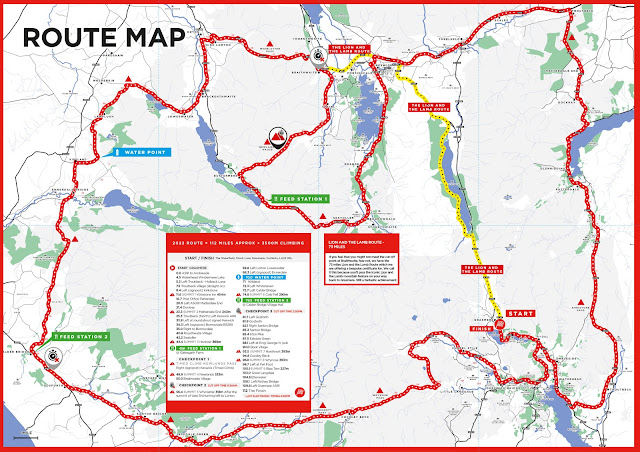
Route map for Fred Whitton Challenge

In fact, I ended up not doing the full Monty and opted for the more clement, but nevertheless challenging Lion and Lamb route (yellow line on the route map). Here's what I remember of it. 

When the time came for me to do the event the event I was full of doubt and not really feeling confident that I could go the distance. I had done a fair bit of mileage - around 600km per month, but I hadn't done any practice events or pushed myself in any way. Time had not been on my side.

I had come very close to pulling out of the event. However, when I saw on the cyclosportive race pack that there was a shorter option I immediately decided I would go. The shorter route is known as the Lion and Lamb. Basically you ride the route of Fred Whitton, taking in Kirkstone Pass, Honister Pass and Newlands. Then when you reach the village of Braithwaite, instead of turning left to go up Whinlatter Pass you turn right and head back to Keswick. Then from there you take the direct A591 road back to Grasmere. 

The route is so called because the rocks along the side of the road, known as Helm Crag resemble a Lion and Lamb, though I must say I fail to see the resemblance! 

When I arrived in Grasmere on the eve of the ride to pick up my race pack, it was only then that I became aware of the magnitude of the event. The field around the race HQ had been turned into a massive car park as folks arrived from all over the UK to take part. There were stands selling bike equipment, clothing and nutrition, as well as a MacMillan Cancer stand, to which funds from the event would go. [Note, Fred Whitton was a member of the Lakes Road Club, who died in 1998 aged 50.]

Overall, there was a buzzing atmosphere and it was all-go in Grasmere. I managed to get in a little ride around the roads near where I was staying in Bowness-on-Windermere, though not on the actual roads of the route. But the fact that I had ridden on the main climbs a month earlier gave me the confidence to take on the challenge, even if I wasn't going to be quick.

Come the following morning, I was feeling fairly languid about the ride. Although I woke up very early - around 5.30am - I didn't want to rush myself. The importance for me, was about going out and enjoying a ride around the Lake District without getting stressed about making the cut-off. If I reached Bu by the cut-off at midday, then I would continue on to the long course. But knowing that I had the Lion and Lamb ride to fall back on (which was doable), I felt quite relaxed about things.
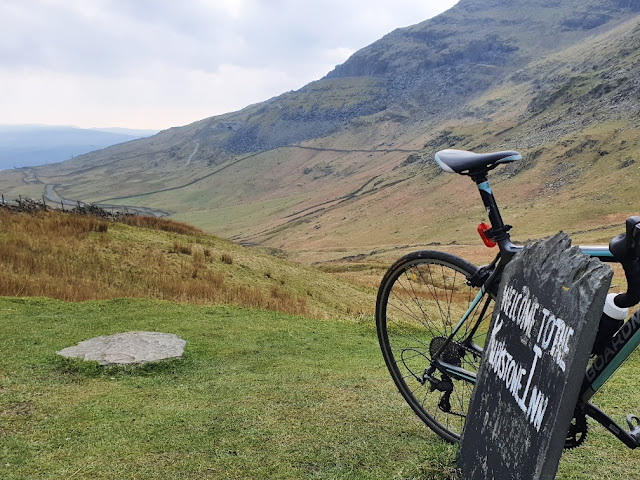
Summit of Kirkstone Pass

On the drive from my lodgings to the event HQ lots of riders passed in the opposite direction, ready to square up to the first difficulty of the day - Kirkstone Pass. All the riders looked lean and mean, riding in various small groups. This was quite the different from the figure I would be cutting. Yes, I was feeling fit, but far from being the finely tuned racer. I had no plan to ride in any group, and I would be carrying my trusty rucksack - hardly kitted out for a race-pace ride. As a result of my leisurely attitude it was almost 7.45am when I took the start line, and only minutes before the deadline for starting the ride. [Riders are allowed to start the Fred Whitton Sportive at any time of their choice between 6am and 8am.]

It was a largely solitary ride as I wound my way along the A591 back towards Windermere. Apart from a couple of groups of riders I hardly saw anyone else. Well, at least I could ride at a pace that was comfortable for me, and I wouldn't feel under pressure to force my pace.

On this early crisp and sunny Sunday morning I wasn't in a mood to remove my jacket and kept on all my layers. Once in the Windermere area I hit Kirkstone Pass via Holbeck. My experience of this climb had been via The Struggle - a 25% beast from the centre of Ambleside. As Holbeck was not such an infamous climb as the ramp from Ambleside, I hadn't expected it to be too difficult. However, I was wrong. Perhaps it was the time of morning, and maybe not being fully warmed up, it was deceptively testing. The bumpy rutted road surface didn't help matters either, as I had to expend extra energy to roll my bike up this heavy narrow road, closed in by woodland and farmhouses. At that moment I began to wonder not just if I could make the midday cut-off at Buttermere, but if I would finish the short ride before they closed the event at 6.30pm!

Just when I was wondering why the hell I'd let myself into this undertaking, my view opened up and I got sight of the familiar countryside that I had seen a few weeks earlier during my Easter weekend in the Lakes. Then the Kirkstone Inn came into view and that was reassuring too.

At the summit, knowing that a long descent lay ahead, I stopped to put on my jacket and grab a quick snack. What was also reassuring was the sight of other riders at the summit. As I moved off, they stayed where they were to sort out a mechanical, while another guy appeared to be just having a morning coffee. So at least I knew I wouldn't be last.

Whizzing down Kirkstone was a real joy, though it wasn't the time to become too complacent as the descent still required skill on a few technical bends. 

A left-hand turn took me into Matterdale where the scenery was stunning. That would be a recurring theme throughout my day. It was desolate but in a peverse way, still an inviting place. Given that I was in a cyclosportive this was not the time to stop for picnics or take photographs, though.

On reaching the junction with the A66, I met some volunteers who checked I was okay and warned me to be careful on the road. This is one section of the Fred Whitton Challenge route, that I am not a fan of, as it runs along a fast trunk road. Thankfully, a side section of the road was coned off, so I was sheltered from the worst of the traffic. Furthermore, it was still only mid-morning and on a Sunday the traffic wasn't heavy. Seeing the sign for Keswick was a welcome indication that I would be back on quiet roads for the rest of the ride. In this gateway town to Borrowdale, I knew exactly how to reach the road to Honister Pass without the help of the signboards or marshals, having reccied it just three weeks earlier. 

Given the time, and the fact that one of the toughest climbs would be appearing before long, I took the opportunity to stock up on fuel and take a toilet break near Derwentwater. By this time, I was all alone, having been overtaken by the other riders who'd had the mechanical at Kirkstone Pass. Maybe I should have felt concerned that there was no one else around, but in fact I felt free - free to just ride around at a pace I was comfortable with, and free to stop when I felt like it. I had food, drink, extra clothing if needed. Granted, I didn't have tent or bivouac, but if I did end up staying out so late I had money to stay in some lodgings!

Although I wasn't riding in any group, the number on my handlebars showed that I was still part of this event which is well known among all the locals. Many people who saw me ride by, applauded and cheered me on, even though I hardly looked like I was in any race. That was jolly nice of them.

Just after the village of Seatoller came one of the hardest climbs of the day - Honister Pass. It was important to remind myself that on my previous attempt I had managed to get up this 25% ramp without walking, even if I had almost pulled a wheelie in the process. If I kept that in mind, and stayed calm, I would be okay. The next half-mile became all about straining every sinew to keep the momentum moving forward especially on the hairpins, and hope that no vehicle would approach in the opposite direction along this narrow road.  

Once past the worst section of the gradient, I felt enormously relieved, though I was panting too much to have any real appreciation of this mini success. A car did emerge in the opposite direction, on the merciful 10% section. The driver kindly stopped to let me pass by as she gave me a big thumbs up while I trudged passed barely conscious.

Soon the road took me past a slate mine and then the Honister car park and tea room which marked the end of my climb and the start of the big drop down to Buttermere. By this time I'd got my breath back and was ready to celebrate my achievement, but this was no time to be complacent. I still had some way to go. 

However, it was at this point that I realised I would miss the cut off to do the full Fred Whitton Challenge, so my ride would now just be a mere 73 miles instead of 112. Furthermore, I would be deprived of the chance to ride up Hardknott and Wrynose Passes. Should I have felt disappointed? Maybe, but I wasn't! Having experienced these two beasts a few weeks earlier, and spent most of the time on foot rather than on my bike I knew that I wouldn't stand a chance of riding it during the cyclosportive, particularly as those climbs don't appear until around 95 miles into the ride! So in effect, the hardest climb of my ride was behind me, and everything from here on in would be straight forward....sort of.
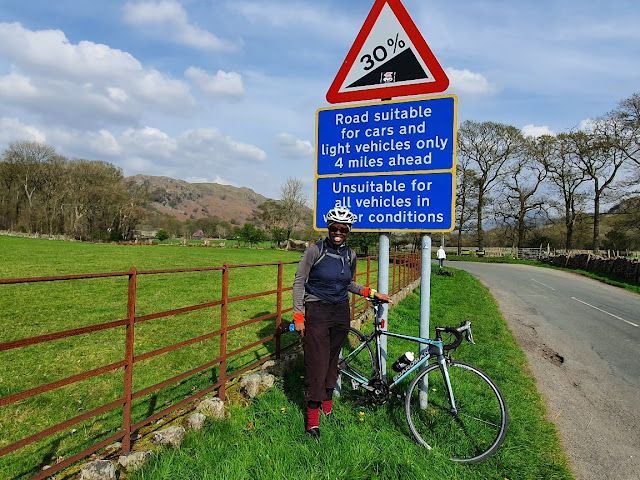
The road to hell - aka Hardknott Pass - which I skipped in FW Challenge (thankfully)

Rolling down the Honister Pass is not the easiest of descents. Just as 25% uphill is tough, the same percentage downhill is no breeze. Control and good bike handling are required. I remember a woman crashing on this descent a few years ago and fracturing her skull. Er, I'd rather that didn't happen to me. So for those first couple of kilometres there was a lot of focus, as I made use of my descending skills learned (thankfully) from a few years of cyclocross. 

Nevertheless it has to be said that the area was breathtaking in more ways than one. The descent had me panting as the road snaked and sank between the stunning Buttermere and Borrowdale valleys. 

Eventually the gradient levelled off and my ride became more manageable, and this allowed me to appreciate the landscape, which was dotted with little streams, as well as sheep that looked on at me curiously. They probably wondered what this odd person was doing on their patch with a number on her bike and no peloton!

As expected, I missed the cut-off to continue on the main route, which was evidenced by the sight of organisers closing feed-station and the first-aid ambulance driving away. Good job I had my own supplies, as I tucked into another energy bar.

A couple of miles earlier a guy on a road bike had passed me and said hello. I assumed he was a participant in the cyclosportive, given the speed he passed me, and he must have had a mechanical that was now resolved. 

However, about 200m down the road I realised he was slowing down as I began to catch up with him. These moments are always a bit tricky for me. I think to myself, "If you ride so much quicker than I do, why overtake and then slow down? Then I'm going to catch you and you'll chase me down again...What's the point in that?" I'm never keen on this silly cat and mouse game. 

Initially, I began to slow myself down, in a hope that he would pick up pace again. It didn't work though, because it would be ridiculous to ride even slower than my already snail pace. Eventually I caught up with him, as he was stood admiring the beautiful Buttermere Lake.

Soon he caught me again, but rather than pass, he rode alongside me and struck up a conversation. "It's beautiful around here isn't it?" He said. It turned out that he had come across to the area from Newcastle with a friend who was taking part in the cyclosportive. He had failed to get a place during the lottery draw for the event, but came to the Lake District anyway to provide support for his team-mate. Knowing the route, he was happy enough to ride around the areas on the day and soak in the atmosphere. I'm not sure if my pootling along the course on my own provided much atmosphere!

We rode further on together, and began the climb up Newlands Pass. That was where I hoped he would leave me to my own devices, as the road became decidedly steep. Of all the climbs of the Fred Whitton, Newlands is the one I know the least. Despite having previously done the Fred on a couple of occasions I still couldn't remember much about this pass across that crosses the valley to reach Keswick. My assumption is that if it didn't stand out in my memory of the event it can't have been that tough. However, I was wrong. When inspecting it on an Ordnance Survey map this yellow road shows double arrows, denoting it being >20%. I wasn't looking forward to that. My new found pal eventually bid me good bye as he said he was going to explore other roads. Before leaving he described the rest of the route beyond Newlands Pass and gave me tips. Nice of him, but I did already know the route. I guess, judging by the way I waddled along he thought I was a newbie. And I must say, I felt too embarrassed to say I was a little bit more experienced than that!

Climbing up Newlands Pass didn't fail to disappoint, when it came to gradients. The narrow road wound around, up and up past the Moss Force waterfalls. At one point I really felt like I was in some kind of middle Earth as the place was desolate and looked a little grey. Funnily enough, I still think it looked beautiful. 

Only a couple of cars passed by, and like other motorists - as had been the trend on this day - they tooted their horns and either gave a thumbs up or shouted "well done" at my efforts. I certainly appreciated the encouragement as this road had a very sharp hairpin with a ramp that must have been in excess of 20% - not as steep as Honister, but tough enough. It caught me quite by surprise. With my remaining energy I squeezed every muscle to propel myself forwards. Thankfully, the road levelled off and then very shortly afterwards my bike wheels began to turn faster and faster as the road gently descended, and then I was rolling at full velocity, enjoying a lovely downhill towards Braithwaite. 

Apparently this quaint village is where your morale is made or broken a marshal determines whether you have a long or a short day on the roads of the Fred Whitton Cyclosportive. A left-hand turn takes you up Whinlatter Pass, out towards Cockermouth and then down to Eskdale Green where the dreaded Hardknott-Wrynose duo await. Alternatively, you can turn right towards Keswick and then take main road straight back to Grasmere. Depending on your persuasion your moral could be up because you're doing the long challenge, but also because you are doing the short challenge and can look forward to a relaxing afternoon. 

This right-hand turn could be a source of despair and disappointment at the hands of the marshal who has the interesting job of telling you you've missed the cut-off. Otherwise, it could be a moment of relief that it's official - you are on your way to an early finish that, with any luck gives you the time to enjoy a leisurely Sunday lunch and an afternoon walk. This was definitely my attitude. In fact, I was so late that the marshal doing this job had already packed up and gone! For a fellow rider Sonia from Bolsover, who I met on the day, she definitely had a sense of  the former. The right hand turn left her and her friend very disappointed and frustrated. Unfortunately for her, she was the woman I had passed at the summit of Kirktone Pass earlier and had had to deal with a problem with her gears. She and her friend had ridden like the clappers to make it to Braithwaite, only to arrive 15 minutes too late.

Fortunately for me though, it meant that doing the short course meant that I was able to have a very pleasant lunch with her back at the HQ.
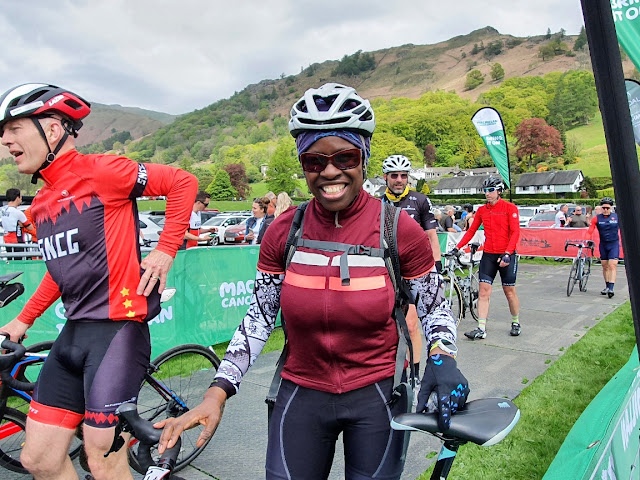
Very happy to reached the finish line - even if I "only" did 73 miles

So after the right-hand turn at Braithwaite and a very pleasant descent in the shadow of Skiddaw mountain, I was back into Keswick, which had begun to feel like a second home, given that it was the second time I was passing through there on this day, and I had also been spent time in the village just a couple of weeks earlier. The roads and buildings were very familiar and I knew exactly which way I needed to go to reach Grasmere - handy given that there were no more signs or marshals. Sadly, I had forgotten about the steep exit to reach the homeward road, and I must admit that at this point I was beginning to feel the effects of the rugged Lakeland roads. It was a tour de force to winch myself over the 12% ramp, and even after that the main A591 was an unrelenting sequence of ups and downs, not to mention a slight head wind.

This section of the Fred Whitton Challenge is not the official course, and it's not publicised on the website. It was only when I received the pre-race pack that I became aware of its existence, and as such there were hardly any other participants on this road. In any case, it didn't make much difference to me as that had been the pattern throughout my ride even on the official route!

I was confident that the final 13 miles back to the HQ would be doable and my energy levels were high enough to get me home. I was far from hitting the wall, but I must admit I was getting a little bit bored, and the constant ups, downs and twists in the road were demoralising. Some sections had slight cross winds, and it has to be said that the there were some dual carriageway sections with fast-moving traffic so it wasn't a totally relaxing ride.

And where was the famous Lion and Lamb to keep me going? Apparently, you are meant to see these shapes in the nearby hills but I couldn't see anything of that description. I can only conclude it must have been something dreamed up by someone while they were on some fun pills. Of course, I am happy to stand corrected if someone sends me the photos.

About half-way along the road a guy passed me, going at a fast pace. That was reassuring to see that it's not just the slow coaches like myself who do this route. Soon after, a woman caught up with me. "It's not very easy here is it?" She said. I agreed. At first, I thought of hanging onto her wheel so that we could do a triumphant return to the HQ together - a sisters in solidarity moment. But she was actually stronger than I was, and as the wind subsided she gained a second wind herself and dropped me. No bother. I was just happy to have seen a couple of souls along the road, albeit briefly. That was enough to reassure me that I wasn't the only cop-out cyclosportive rider in the village.

Finally, the signboard for Grasmere came into view and the crowds along the roadside thickened as locals, friends and family cheered on every rider who crossed the finish line. I had a big smile on my face and a sense of achievement that I had got through the 73 Lakeland miles without wrecking myself - denoting that I probably had been strong enough to do the full thing had I set off early.

One guy who crossed the finish line at the same time as myself did say that I looked suspiciously fresh. So I felt obliged to make my admission, to which he replied - as long as you were in pain on Honister then you did it well. Well, it was painful, so I felt I must have done a good job.

Enjoying a post-ride walk around Grasmere and Rydal Water

Regardless of the fact that I had done the short Fred Whitton ride, it had been a satisfying day out,  I had done an honest day's work in the saddle, and I think I deserved my post-ride pie and chips. Then the day was rounded off with a beautiful walk along the trails surrounding Grasmere, Rydal Water, and Rydal Caves. I know I must go back to the Lake District and do the full Fred Whitton route at some point; though not for now. Hardknott and Wrynose may have to wait a little bit longer.

Related posts

Tackling the Lake District climbs

The Struggle is real in the Lake District 

Crystal Palace hills

Monday, 19 September 2022

Freewheeling - Farewell Queen Elizabeth II (Elizabeth Mountbatten-Windsor)

Ride in Peace Elizabeth II (Photo: Getty images)

It has been a surreal 10 days or so since the death of the Queen was announced on 8th September. That day is definitely another of those "Where were you when....." moments. 

The news is not quite as shocking as with Princess Diana, when we really didn't see that coming and woke up to the shock news, one Sunday morning in August 1997, of the fatal car crash.

Also, with the Queen being 96, increasingly frail and cancelling more and more engagements you got a sense that the end was coming sooner or later. even if, as Boris Johnson said, people had a child-like belief that she could live forever. Sadly it wasn't to be.

So when I saw Prime Minister Liz Truss and Labour opposition leader Keir Starmer suddenly leave the House of Commons during an important televised debate, I realised there was a serious issue. It was underlined even more by the fact that during the lunchtime news that followed, the BBC News readers wore a black tie and jacket and all television programmes were cancelled as we watched continuous news about Her Majesty. We received updates on various members of the royal family travelling up to Balmoral to be with her - even Prince Andrew and Prince Harry.

Finally, when newsreader Cathy Newman of Channel 4 interrupted the episode of Hollyoaks I was watching, to deliver the solemn news I felt a combination of sadness and loss. It was like we had come to the end of an era. I had only ever known of the Queen as our head of state. As a child, whether it was at school or even at the Brownie Guides we were taught to respect the Queen. I recall as a child loads of fanfare around the Silver Jubilee in 1977. We lived in Nottingham at the time, and I have happy memories of me my mum and my sisters standing and waving at her as she drove past on a visit to our city. 

I must say that she seemed much more of a figurehead for the United Kingdom than any of our Prime Ministers. She always conducted herself with great dignity and correctness, and clearly demonstrated an enormous sense of duty by the way that she always turned up at events come rain or shine - be it to visit a hospital, open a community centre, a supermarket, or presenting folks with their medals - as well as visiting and welcoming heads of states of all hues and characters - from Nelson Mandela to Nicolae Ceauşescu.

I hadn't expected to be as saddened at her passing as I thought I would be. There was a sense of the country being slightly rudderless as we had a new Prime Minister and a departed monarch. 

With Queen Elizabeth II now laid to rest we can begin to get some closure and get used to our new monarch. I fully support Charles III becoming the new sovereign, but the fact is with the best will in the world he can't be like his mother. For a start, given his advanced age when commencing the job he'll do well to get to celebrate a Silver Jubilee. 

Charles is a king for the modern era and with that comes very different styles and ways of doing things. Elizabeth was of that era where things were much more formal, with a strong sense of protocol and duty, and you never really knew exactly what she was thinking. She just got on with what she needed to do, never complaining or explaining.

You couldn't imagine her getting into a strop and shouting "Oh this bloody pen" when signing an official document! It was against protocol to touch the Queen apart from to shake hands. But the King has allowed well-wishers to hug him, and he even let one woman kiss him. So we are already seeing a different type of monarch. 

Looking at the various tributes and stories about the Queen, I have learned how physically active she was. We all know about her love for horses and corgies - it was a sorry sight seeing her pets outside Windsor Castle as her coffin was carried into the Chapel. 

But it was very interested to learn about the other activities she did. She had been a car mechanic, and had learned how to strip down an engine. She learned to ride a motorbike too. There is a photo of her practicing riding around cones on what looked like a Royal Enfield motorbike. Prime Ministers have also told tales of how they clung on for dear life in her Land Rover as she drove them around the grounds of Balmoral like she was in Rally race! And of course she liked to spend hours hiking around Balmoral too.

My favourite picture, has to be this one of the teenage Elizabeth, taken while out cycling with her younger sister Margaret. I must say Elizabeth does look stylish on the bike. She would have looked well at home on one of the Tweed Run rides that is organised around London!

Without being really overt about it, Queen Elizabeth was a bit of a feminist. She was one of the earliest examples of a working mum - becoming Queen while Prince Charles and Princess Anne were toddlers. She ended up spending a lot of time away from them, but by the time Andrew and Edward were born she had got to know the ropes of the job and did take on the role of juggling "stay-at-home" mum while carrying out her duties. 

It was also under Elizabeth's reign that the laws of accession were changed so that women could become the direct heir to the throne, rather than being placed behind the men in the family. So Princess Charlotte (her great grand-daughter) is now third in line to the throne, where previously she would have been placed behind her younger brother Louis. 

I have a lot of admiration for the subtle influence the Queen had on our lives and I will miss having a monarch as dignified as Elizabeth II. 

Saturday, 3 September 2022

The Monkey Motorbike Diaries - Episode 2

On Farthing Downs
Having this new type of two-wheeler has been great for getting out and about around London. I feel good about going out to other places. It's true that I can cycle to places, and that's something that I still do. But it's good to have that extra option of being able to ride to somewhere relatively quickly. For example, I can go into central London in half an hour, totally bypassing traffic jams that hold me up when in the car. Also, there's no congestion charge to worry about, and parking is generally free (apart from Westminster where you pay £1 for the day).  

Another use I have found with the motorbike is to get me to other parts of London in order to go running. I have aimed to get to different places each week to do runs. As well as it involving the fun of riding my motorbike, it also gives variety to my runs and keeps them interesting. I have been to Brockwell Park, Tooting Bec Common, Docklands, Peckham Rye, and on this day Farthing Down in South Croydon. It was an early morning start to get over to Coulsdon, and then I did a long run through the woods and was home by 9am in time to start my working day.

I have also used the bike to go to different outdoor swimming venues - to Canary Wharf, Royal Victoria Docks, London Fields, and then to Divers Cove in Surrey as well. 

I really enjoy the combination of getting in the practice on my motorbike, riding on different types of roads, as well as keeping fit.

I am not sure if I am a proper biker type though because it seems that real motorbikers get on their bikes and ride out to a cafe - maybe have a fry-up and then ride on to somewhere else and do another cafe stop. It has to be said that there are quite a lot of riders who are of a larger size. I wonder if all these rides to cafes are a contributory factor. Whether or not that is the case for them, I know for sure that I would definitely be twice the size that I am now if I used my bike to ride out to cafes every weekend. With that in mind it makes me wonder if I should join a motorcycle club if I am reluctant to do these types of cafe ride. Surely a motorbike rideout can be mixed in with say swimming, running or hiking and then the sausages and bacon afterwards, right? I would gladly welcome any suggestions of clubs that focus a little on other outdoor activities aside from motorbike riding. Or maybe that's an unreasonable expectation to think that these sets of lifestyles are not mutually exclusive. I hope that's not the case.


Related posts 

The Monkey Motorbike Diaries - Episode 1

Thursday, 1 September 2022

Freewheeling - Keeping away from cycling activists

As someone who is into cycling I have found that my love for the activity has slightly waned of late. It's not that I have gone off cycling. It's more to do with all that swirls around it. 

I have always had a fairly simple relationship with bike riding. I get on my bike, I ride. Sometimes it is for a leisure pootle, sometimes for training, or for racing. Other times it's just to get from A to B. I could be riding in London streets, on country roads, or along off-road trails. 

Normally, whichever sort of bike riding I do, I always enjoy it and find it a pleasant space away from the more humdrum activities of everyday life.

However, in recent times I have noticed that cycling has come very ...politicised. Whether it's folks going on about the safety/lack of safety on Britain's roads, sexism, racism, all other sorts of -isms, sustainability, clothing sizes for women, colours, sponsors of cycle races and teams, even bike brands. Whatever is happening in cycling it just seems to attract some sort of shouty reaction from certain quarters, all aired on Twitter - of course. It's all a bit much for me. 

I just want to ride my bike and not give it too much thought. Apparently, even that puts you at loggerheads with folks. Folks have been known to throw at me the accusatory phrase - "If you don't see a problem then you are part of the problem." I am supposedly meant to feel guilty about this.

Let me elaborate on a couple of things:


Race and cycling

Last year, I was asked by a cycling magazine to write an advertorial for a clothing brand. This would have involved interviewing two black women - one of whom has a large following on social media - and who has been vocal on racial matters in cycling. She set up a group known for women of colour who cycle. I don't particularly agree with such groups forming based purely on race. It is a view I am entitled to, though as a professional journalist my personal views do not influence the way I work. However, I was later informed by the editor of the cycling magazine that I was being removed from the job because the two black women asked not to be interviewed by me. Apparently they didn't approve of my views. 

The advertorial was going to be related to training to cycle 100km - nothing to do with a person's race, but yet I was removed from the job! So suddenly I became the subject of "cancel culture". Ironically, these are the same women who campaign saying "representation matters" and want visibility of black people in various roles, including journalism! Absolute hypocrisy. I must also add that in the 12 years I have been involved in journalism this is the only time an interviewee has asked to not be interviewed by me.

I first became involved in club cycling in 2000. At that time there were hardly any black people who took part in club cycling. There were a few; just not many. Nevertheless I found the cycling community to be very welcoming. Sure it was dominated by white males - maybe even middle-aged, middle class males. I didn't ask them their ages or their class, and even if I could have taken an educated guess, I couldn't really have cared one way or another. I was just interested in being in a friendly environment, and that's how I found the cycling milieu to be. 

Fast forward twenty years and everyone is talking about cycling being racist and that the lack of black people involved in cycling is because we were being excluded. No one ever stopped me from riding a bicycle or taking part in events. 

I am not saying that I don't believe other people who say that they had a negative experience, but I think it's important to realise that people have different experiences in the same situation. When I say that I have had a positive experience I don't see why folks should look at me negatively. It's almost as though I have committed some sort of sacrilege because I am not going out and mouthing off about breaking down barriers. 

In my time I have known many black people (including members of my own family) who are just not interested in cycling, and who even wonder why I do it! That's been my experience, and for me to believe that the lack of black people cycling was down to personal preference rather than racial bias was not an unreasonable conclusion to draw. Because of that, some see me as a pariah for not joining them in their crusade. One black guy who has made his name by hosting an exhibition about Black Cycling Champions and claiming that cycling is a racist sport even blocked me from his Twitter account!

It is interesting how some of these people campaign for inclusivity, but yet their behaviour, by its very nature, is to exclude those who don't share their opinions.  


Militant Cyclists 

I have ridden bicycles around since the 1970s. My time as a commuter cyclist in London began in 2001. Back then, there were make-shift cycle lanes - mainly a line painted along the edge of the road but you weren't separated from traffic at all. I remember the first time I cycled from my home in Crystal Palace all the way to my office at the time, which was in Marylebone, I rode ever so cautiously and was quite nervous. But in fact, it wasn't bad at all. I quite enjoyed the experience and I was happy to continue riding my bike through the London. I have commuted by bicycle ever since. 

Nowadays we have the luxury of segregated cycle superhighways and special cyclist traffic lights to get you across busy junctions. I think these are great additions and have been instrumental in encouraging more people to cycle in London. I think that London is now an even better place to cycle, and its facilities are now comparable to (if not better than) some other major cities around the world. I can confidently say this as I always make sure to ride a bicycle (either my own or a hire bike) whenever I travel abroad. So I have ridden bicycles in cities around Europe, North America, South America, and the Caribbean, in my time.

The thing is, whenever I look at Twitter I see angry messages from various people about how terrible it is to cycle around London. I just don't share that experience with others. Sadly, if you respond on this platform saying that you have had an enjoyable experience people lambast you saying you don't know what you're talking about and asking you to produce statistics.

Campaigning organisations also want to suggest that every other city in Europe has better cycling infrastructure than London. I would take them seriously if the protagonists actually regularly commuted in those countries. Many of them have never cycled abroad - or at least when they cycled abroad it was in a holiday resort within that country as opposed to a city where people get on with daily life. These are not even like for like comparisons, so folks then draw their conclusions based on photographs of cycle lanes in these cities! 

A recently constructed segregated cycle lane in central Paris, running along rue Saint Antoine from Bastille to Chatelet, and on to Rivoli and Concorde has received much praise on social media. Granted it is a very useful cycle lane. But is this segregated lane better than an equivalent one in London? And does it mean that every cycle lane in Paris is in the same style as the one on Rivoli? 

I get astounded by how people take this cycle lane and extrapolate saying the whole of Paris has cycle lanes like this, and life as a cyclist in Paris is much better than in London! Have these people never ridden the Cycle Superhighway from Elephant and Castle to Clerkenwell? Or the path from Tower Bridge through Westminster all the way to the Royal Albert Hall? What is the difference? In fact I would argue that the London segregated paths are better than those in Paris because they are completely closed to motorised traffic. Cycle lanes in Paris still allow space for delivery vans - and the van drivers make the most of that permission! You certainly have to be on your guard when riding in a bike lane.

Then of course there's the "we hate cars" brigade. Activists have even taken to deflating the tyres of SUVs under cover of darkness and leaving notes reprimanding them for owning one. Interestingly, these will be the same people protesting against the regimes of Vladimir Putin of Russia, Kim Jong-un of North Korea or Xi Jinping of China. But yet, these urban rebels feel that it's okay to disrupt the lives of people who don't embrace their beliefs and behaviours.

And let's not forget the countless cyclists who jump the red traffic lights - some with fatal consequences. Campaigners continue to lambast terrible drivers of motorised vehicles. If you dared to question cyclists who flout road traffic laws they give a response along the lines of cyclists don't kill people when they don't jump lights. Some even refuse to acknowledge that this law-breaking occurs.  

I don't understand how they can't see that this brand of self-righteousness, and thinking they are above all other road users just doesn't endear them to the general population. It's not surprising that folks make negative comments about these militants on pushbikes, and display negative behaviour towards them on the roads. Travelling around a town should be about sharing the thoroughfares, not occupying them to the exclusion of others.

And so, in the climate of what I have mentioned above, I find it quite difficult to call myself a cyclist. I get concerned that people may automatically picture me as one of those scary angry folks who jumps red lights and refuses to give way to any other road user. 

These days I prefer to consider myself as a person who likes to travel by bicycle, among other forms of transport. In addition, I like to do club cycling and cycle races, as well as other sporting activities. I think it's better to not let myself get too immersed in the chatter of activists and militants.

It's nice to see that more and more people are taking to push bikes. London has definitely become more of a cycling city, than ever before. Though I must say that I personally don't feel any push to say that everyone should ride bikes, though I wouldn't dissuade it either. And I certainly don't believe that anything in society is discouraging others from getting into bike riding if that's what they want to do.  

Above all, bike riding is always about choice. You make your choice and respect the choices of others. Sadly, I think that what I have said here sounds much too reasonable, and is likely to once again attract the ire of others.