Thursday, 29 June 2023

Wanna do the Paris Triathlon? What you need to know

Paris Triathlon details

  • The Paris Triathlon usually takes place in June. There is a sprint distance, which is what I did - 550m swim, 21km bike, 6km run - that takes place on the Saturday. The Olympic distance race - 1500m, 40km, 10km run on the Sunday.
  • The event is based at Parc de la Villette in the 19th arrondissement, with the swim taking place in the Ourcq Canal. 
  • The bike route goes into central Paris and back, passing some well-known landmarks. On both distances you go via the Canal St Martin to Republique, through Bastille, and along the River. In the sprint race the riders do a U-turn at Place de la Concorde to return to Parc de la Villette. 
  • In the Olympic distance the riders go up Champs Elysees and do a stint through the Bois de Boulogne before returning to the triathlon event village. 
  • Parts of the course have cobbles, though not extensively. Also be careful of sharp right or left-hand turns, and check around you before changing your line.
  • The race is supposedly non-drafting, but with the numbers and on this type of fast, mainly flat course it's hard to avoid doing so!
  • The run goes up one side of the Ourcq Canal, heading East to the suburb of Pantin, then crosses the canal at the half-way point to head back to the finish line in the event village.
  • This year, for the first time they included a duathlon, based on the distances in the sprint triathlon. Competitors did the same as the sprint triathletes but the swim was replaced with a 5km run.
  • Around 5000 athletes take part across all three distances over the two days.
  • It's a mass participation event open to anyone fit enough. The sprint triathlon is accessible to people who are new to the sport, with a cut-off time of around 3 hours to complete the race.
  • To take part, you need to have either a medical certificate stating a non-contraindication to doing competitive triathlons, or a triathlon licence from your country's triathlon federation. If you don't have an annual French Triathlon Federation licence you need to buy a French Triathlon Federation day licence for a nominal fee.
  • Given the numbers of people taking part in the event, you need to rack your bike in transition the day before the event.
  • The organisers seem quite relaxed about the closing date for entry. I entered the triathlon just a week prior to the event! But bear in mind that when uploading accompanying documents (triathlon licence/medical certificates) as part of the on-line entry process the organisers recommend that you allow a couple of weeks for them to validate your documents.
  • The events start around 7am, so you need to get public transport around 5.30/6am, depending on which part of Paris you're in. The metro is running at that time and the most convenient stop is Porte de Pantin on line 5.
  • On the morning of the event you need to be in your start pen about 30 minutes before your start time.
  • The walk from transition to the start pens is around 800m (half a mile) along grass, trails and cobbles. The organisers advise people to wear old trainers which can then be left in designated boxes and donated to charity. I didn't have old trainers so just wore a few pairs of old socks. 
  • As with all major events, there's a bit of a queue for the portaloos, so allow lots of time.
  • There is a staffed bag-drop area for your post-race gear, though there are no changing rooms or showers. Some people just got changed in the grassy area around the event. I was happy to cycle back to my lodgings after the race and get changed there. 
  • If you don't want to take your bike or a wetsuit, for an extra fee you can hire a "triathlon package" for the event from the organisers. It includes a bicycle and a wetsuit, plus other triathlon gear.
  • There's a great atmosphere at the event, with lots of spectators.
  • The 2024 date has not yet been announced, though it is possible to register your interest in order to receive news about it, including the date.

My logistics for the race
  • I travelled to Paris from London with my bike. I packed down my triathlon gear (including my wetsuit) very small so that they fitted into my bikepacking bags - one on the saddle, and the other on the handlebars. I also carried a small rucksack.
  • I caught a train from East Croydon to Brighton and then cycled to Newhaven. There was the option to catch a train from Brighton to Newhaven Town.  You can also go by train from East Croydon to Newhaven Town (with a changeover at Lewes). There was a further option to ride from Crystal Palace to Newhaven, but I didn't have the time to do that! Train tickets cost anything from £9 to £29 depending on which route you take, and if you book in advance on-line to travel on Thameslink or Southern Trains.
  • I got the 5pm ferry to Dieppe and arrived there at 10pm local time. Ferry tickets cost around £28 each way with DFDS, though can be a bit higher depending on the service.
  • My accommodation for the night was an apartment less than 10 minutes away from the Ferry terminal. Newhaven is quite a compact town. There are also reasonably priced hotels nearby. The flat cost around £40, while the hotels are a little bit more.
  • It was possible to get a train from Dieppe through to Paris (with changeover at Rouen). Both trains are regional (TER) so you just carry your bike on and put it in the provided bike space for free. You can buy tickets at the train station, but these days the French railway company, SNCF, are on a drive to get people to book on-line via their portal SNCF Connect. You are then more likely to get cheaper fares in advance. Also, if you book on-line then you can make changes to your ticket. Fares vary alot - from about 12 Euros to 30 Euros. 
  • If you're feeling really energetic you could ride the 120 miles all the way to Paris. Or you could go part way and ride about 35 miles to Rouen, or 60 miles to Beauvais then get a train to Paris. I cycled 20 miles to Auffay and then got on a train.
  • The train from Rouen arrives at Gare Saint-Lazare, while a train from Beauvais goes to Gare du Nord, both stations being in central Paris.
  • I stayed in an Aparthotel at Maisons-Alfort, a nearby suburb of Paris, just to the East and next to the 12th and 13th arrondissements of the city. It was close to the woods (Bois de Vincennes) and was on the metro (line 8, Balard-Creteil). Bear in mind that Paris is a very compact city, and although I was in the suburbs I was still only about a half-hour bike ride from the touristic parts of Central Paris.
  • Staying in an apartment meant that I could go self-catering and eat the food that suited me for the event. Where I stayed was very conveniently located close to a supermarket.
  • The triathlon took place in the Parc de la Villette, in the 19th arrondissement, North-East of Paris. It was about a 40-minute cycle ride from where I was staying. Once the triathlon was done it was an easy bike ride to get back to my lodgings.
  • The metro took around the same amount of time on the morning of the event, and involved a changeover at Bastille to get to Porte de Pantin.
  • Getting home to London was fairly straightforward. I got a train from Paris St Lazare in the late afternoon on Sunday and then took the overnight ferry to Newhaven, then cycled to Brighton to get the train to East Croydon. I was originally booked onto a Sunday morning train in order to get the afternoon ferry from Dieppe, but a puncture meant I missed my train. However, it was straightforward forward to change my train ticket on-line. As it was the weekend, DFDS phone line was closed, so I did have to buy a new ferry ticket. Then the next day I just transferred the original ticket to a another trip in the future. I will definitely be making a trip to Paris with my bike in the future. It's one of my favourite itineraries!

Related posts


Wednesday, 28 June 2023

Back again to Paris by bike - Part 2: Paris Triathlon

Given that I have spent so much time in Paris over the course of my life these days my trips there tend to be for a specific reason. I travelled there earlier this year to go an interview the top brass at Amaury Sports Organisation/L'Equipe Media at their offices just in the suburbs at Boulogne Billancourt. This time I was back again to take part in the Garmin Triathlon de Paris. 


It is an event that I had been wanting to do for some time. Originally I had thought of taking part in a swimming event that took place the week before the triathlon, in the same area - Ourcq Canal. That was going to be just an open water swimming event. I have been doing a fair amount of open water swimming and I felt ready to do an event, but getting to Paris in time for this event was proving tricky logistically. So as a kind of "consolation" I decided to do the triathlon, given that that would involve open water swimming in the same canal, plus a bonus of a bike ride right into central Paris. 

Based to the north-east of the city, in the 19th arrondissement of Paris, the Ourcq Canal is part of the canal network in Paris that includes the Canal Saint Denis and the Canal Saint Martin. The latter connects to the Ourcq Canal via the Bassin de la Villette, a rectangular artificial lake which is the site for leisure activities on the water, including sailing, pedalos and there is a cordoned-off section to form a Lido during the summer months. The wider area, Parc de la Villette is home to a science and technology museum, concert venues, an open-air cinema, and on this weekend, the Garmin Paris Triathlon.  

The triathlon took place at a timely moment for me because I had a medical certificate, and obligatory document that most French sports events ask that you have in order to participate. In fact it was due to expire on 25th June - the day after triathlon. So that was lucky!


Arrival into Paris 

On my arrival into Paris Saint Lazare station, I had initially thought to do the 20-minute ride straight to the Parc de la Villette where I would sign-on for the event, pick up my race pack, and leave my bicycle there overnight. All participants had to leave their bikes at that the transition the day before, given the size of the field - there were around 2000 participants.

Cycle path on the left-bank of the River Seine

But I was not in the mood to get shot of my bike so soon after arriving into this city that looked even more beautiful on this hot sunny day. So I decided to do a mini tour first. It wouldn't do any harm, especially as I had only ridden 20 miles on my stint through Normandy. So a flat 10 or 15 miles were not going to totally tire me out. 

From the station I headed slightly north towards Rome metro station and then cycled along the grand boulevard to reach Charles de Gaulle Etoile. There were lots of cyclists and scooters out, with some on the cycle lanes while others were on the main carriageway. Traffic is quite dense and can be slow-going, even with segregated cycle lanes. So it tends to be every man and woman for themselves regardless of what mode of transport they are on. I guess, as a regular cycle commuter in London this was nothing new to me. 

You have to be careful on the cycle lanes because they aren't 100% segregated as they have openings, notably for delivery vehicles to pull in. The lanes also melt away at junctions and so it's a question of following bicycle markings on the road surface, though not all road users or even cyclists follow them.

My main issue with riding around Paris is the various cobbled sections. I am sure my road bike can handle those sections, but when I am bike packing I still worry that something might get rattled off or break. 

After a mini photo opportunity stops at the Arc de Triomphe, Trocadero (near the Eiffel Tower), and on the river near Alexandre III Bridge, I rode along the lovely cycle path along the river. This path doesn't just go through the famous areas, but also into the less glamourous parts of south-east Paris, after Austerlitz station and near Ivry Sur Seine. In fact I was able to get to my loggings at Maison Alfort via the cycle paths.


Late Registration at Parc de la Villette 

This was the time to drop off my bags and then continue my ride up to La Villette. When I told the receptionist that I would be cycling up to the Parc in the north-east of city, he looked at me like I was mad. He was saying I would need all evening to get up there! Really? I almost began to wonder if it was a strange thing to do.

Well, in fact the route was around 40 minutes along the cycle path on the grand boulevards via Pere Lachaise Cemetery and Belleville. I remember at the time when I lived in Paris I only ever travelled by public transport, and it's true that the idea of cycling from one end of the city to another seemed a long way. In fact, it is when you cycle that you realise just how compact Paris is.

At Parc de la Villette there was a vibrant atmosphere in anticipation of the event, with various trade stalls up, a bit of music and a commentator contributing to an animated vibe. In a way I was glad to get there when I did - about an hour before they were closing the event village - as I didn't have to queue up. The transition area looked impressive with thousands of bikes. I almost wished I'd brought a balloon or something as an aide-memoire for where my bike was. Would I know where to find my bike when I exited the water?

Sign-on at Paris Triathlon Event village

Getting back to my apartment by public transport was straightforward and I had worked out how to get to the triathlon in time for the 7.15am start the following morning.


Early start for race day

The following morning I took a 5.30am metro to Porte de Pantin. Unsurprisingly the train was full of people all dressed in sports gear, showing off their race numbers. Seeing people with the same wave number as myself made me feel reassured that I wasn't late. 

It's not that easy remembering where your bike is among all this!

Setting up my gear in the transition area was easy enough as all the essential items had been left there overnight. I didn't feel too nervous about the event as I considered myself to be just a Jonny come lately who fancied having a go. I knew that I could do all the individual disciplines. I just had to be mindful of not making a silly mistake like not adjusting my goggles properly, or not eating/drinking enough while on the bike.

There was a palpable sense of excitement and nervous anticipation among the participants, especially as I stood in the rather long queue to the portaloo. The walk to the start was a good 800m along the grass and the canal towpath. Many people were wearing old trainers (which could be left at the startline and collected by clothing charities). As I had to travel light, I wore a few pairs of thick old socks.

After a short delay due to the organisers having to remove some parked cars from the bike course the event began, with competitors and spectators alike cheering and applausing each triathlon wave that began before us, and also the single duathlon wave as the participants ran along the opposite side of the canal from us.

Eventually, my wave (wave 3) began and we eased forward through our holding pen to reach the entry point in the Canal Ourcq. Knowing that swimming is my weak point, and not wanting to be caught up in a bunfight in the water I put myself at the back of the pack. I was fine with that. What I wasn't fine with, was the sight of folks at the front of our pen leaping into the water. I was shocked to think that I would have to do that to. Is this a French thing, for participants to leap into the water? Is coldwater shock just a myth that they dismiss? I wasn't looking forward to having to leap into the canal. 


The Swim

Thankfully, as I reached the pontoon I realised that there were in fact two queues - one for those who would leap into the water, while the longer queue was for the majority of us, myself included, who would gently lower ourselves into the water.

My race had finally begun. In the rather warm water, I did a few breast strokes before beginning front crawl, and I was quickly into my rhythm. This was the first time this year that I was doing an openwater swim in a competitive environment. I then had to remind myself of the need to not just be sighting ahead, but also looking out for other swimmers. Even though I was at the back of the pack, there were a few people who swam past me. I am assuming they were late-comers. Furthermore, I began to catch a few swimmers - something that I don't normally do when swimming - those sessions at my local pool in Crystal Palace had obviously paid off. 


The water was surprisingly clear, and I was a bit surprised at how many ferns and plants were in the water. I was also surprised to see how many people were lined along the side of the canal cheering us on. I didn't know who any of the people were, and they hadn't come to see me, but I still felt very spurred on by their support. After what seemed like a short time, I suddenly reached the finish gantry of the swim, where there were steps to take us back onto the towpath, as well as marshals to give us a helping hand.


Rubbish transition 

My transition (the unofficial 4th discipline) was a mess. Firstly, I struggled to get my wetsuit off. In order to cut down on luggage space I took my smallest wetsuit of the three I own - the swimrun wetsuit. I also chose this one because it zips up at the front, meaning I could put it on myself without assistance, and it would be easier for me when doing the last-minute dash to the loo. 

I hadn't thought about how tricky it would be to remove while running from the canal back to my bike. As I clumsily struggled to extricate myself from this stubborn neoprene while running, a fellow competitor stopped to help me. It was really nice of her, and the offer was much appreciated, but I declined all the same - not just because I didn't want to mess up her race, but also because there'd be a risk of disqualification for giving outside help to a competitor. The transition area seemed to be awash with French Triathlon Federation referees, all ready to pounce and be a jobsworth! So I continued my mini contortion dance. 

Once out of my wetsuit I then had to find my bike. I was sure I had come to the right place, but I couldn't find my bike. I almost thought someone had taken my beloved Boardman in the rush. Then I realised I had got my orientation wrong and the bike was at the other end of the bike park - more time wasted. 


The Bike

Finally, I got out on my bike and felt much more in my element. As this was thexsprint triathlon, billed as suitable for all levels of athlete, including newbies, there were lots of different types of bicycles on the road. 

Naturally there were lots of experienced bike riders on expensive road bikes with aero bars, and wearing cleats. But there were also folks on hybrid bikes mountain bikes, even shopping bikes. One woman had a rear-view mirror attached to her handlebars!

Zooming through central Paris

As someone who is used to cycling around the streets of Paris I was familiar with the roads on the course. The big difference was that we were on closed roads and could ride as fast as we wanted (or as fast as our legs would allow) through some of the most famous parts of Paris, with no regard to traffic signs, delivery vans, or pedestrians crossing the roads. It was like doing high(ish)-speed tourism. 

The route went along the Canal Saint Martin, out to République, Bastille, then along the main road that hugs the River Seine all the way to Place de la Concorde. That was the turnaround point, where we turned back and returned via the cycle path along the River. It was a fast mainly flat course where you could do the whole thing on the big ring. My biggest issue was the cobbles. There was a long stretch between Tuileries and Concorde, where I ended up slowing right down and all the people I had previously overtaken could now get their own back on me. A similar thing happened right at the end of the bike course, on the approach through the Parc de la Villette. The cobbles in this area were much bigger than in central Paris. They were more like the big round Roubaix pavé. Knowing that I would need my bike to get back to my lodgings, and also back to London, I preferred to go easy and lose places on the bike leg. 


The Run

By this time the crowds were quite thick, both at the finish of the bike leg, and the start of the run leg. Even though it was a sprint race on largely gentle terrain, the organisers decided to put a sting in the tail by having the run route go over a long flight of steps onto a bridge to cross the canal.

Tough work on the bridge after climbing up 200 steps!
Then it was case of going along the dead straight towpath into the suburb of Pantin, then over a ramp to return along the other side of the Canal Ourcq. Running has tended to be my strongest discipline in the past, but not today. Injury had meant that I had missed out on running training, so was not on form. 

So this was just going to be a 6km survival run, going past the less visited parts of Paris - train tracks from the Gare de l'Est with disused locomotives, old containers, disused factories. Then later there were working class blocks of flats. There wasn't really anything to keep me going. I just had to steal myself and believe I would get through it in the mounting heat. 

I didn't feel that strong, especially as many runners overtook me. There were still folks going slower than me, with some even reduced to walking. 

Fortunately another runner was going at the same pace as myself, and we ran side by side for a few miles. There was no communication between us. We were aware of one another, but were focused on our respective races - living our own tribulations. I didn't feel bothered to have the lady running close by - it was good to have someone to keep me going. 

Then in the last couple of kilometres she put in a spurt, and I just couldn't keep up with her as she disappeared into the distance. It was hard to know where the finish gantry was as it was around a bend. Eventually, I passed the familiar spot where it had all begun a couple of hours earlier. I therefore knew I had 600m to go. 

The crowds began to thicken again, further confirming that the challenge was coming to an end. At that point I put in a final effort of what I could muster, as well as putting on my most presentable face for the finish line photograph. Immediately after crossing the finish line I felt like I was going to throw up. Thankfully I managed to hold things together, which was the better thing to do, given that there was a camera interviewing an athlete right next to me. 

Glad to have made it to the finish line!

Medal Saturday!

After a minute I had a big smile at the thought that I had completed a triathlon in my favourite foreign city. At the post-race feed station I saw the lady who I'd run with earlier, and we congratulated each other. She said she too had been suffering on the run, but found a second wind after the turnaround point. 

Who knows, maybe I will see her in another race in Paris in the future. After the customary medal and T-shirt I was able to have a sit-down in the park and enjoy my achievement in the sunshine.


Related posts 


Tuesday, 27 June 2023

Back again to Paris by bike - Part 1: Croydon to Rouen

Le Grand Horloge, Rouen

Every time I plan a trip to Paris by bicycle I tell myself "this time I will ride from London to the port at Newhaven." After all, it is just like doing a London to Brighton bike ride, but finishing slightly further to the east, and then letting the boat carry you to foreign shores  well France.

However, when the day comes it just doesn't happen. Too many things to do at home - chores to do, work to complete, deadlines to meet, or just tidying the house means that I get to lunchtime, get stressed that I've cut things fine. I also realise the amount of luggage I have packed won't allow me to ride at a decent enough pace. So I take the "easy living" option. And that's what happened today. I did a London to Brighton, except that it was by train! I took the 45-minute train journey from East Croydon to Brighton.

Trains to there are very frequent, and there is space for a bicycle, though because the train passes through Gatwick Airport, lots of folks with suitcases also want to hog the area. There are regular trains from Brighton to Newhaven Town, but in order to not feel like I had completely copped out of my cycle touring mission I rode the undulating 10 miles from Brighton to Newhaven port. 

Riding through Brighton is always a pleasant experience. The place seems a lot brighter than London, with it being right on the coast, and everyone and everything seems laid back as I amble along the promenade on the cycle path. Lots of folks are out on the pier, on the beach visiting i360 or are enjoying the rides at the fairground - even though it is a Thursday afternoon.


As I continue along on Madeira Drive, the road becomes more sparse as I pass the back-end of the city. Apart from the Marina and the New outdoor swimming venue, Sea Lanes there's nothing noteworthy. 


Leaving behind Brighton for the port of Newhaven

Then the coastal cycle path ceases to be flat, and joins the undulating coast road. That's when the work begins. From Roedean right up to Peacehaven the road had alternate descents and challenging rises. Granted I could have remained on the low path and taken the undercliff route, but I felt a duty to burn a few more calories given that I had bailed out of my 50-mile bike ride. This main road to Newhaven had a shared use path/pavement, so I was largely separated from the traffic. That was just as well because the rod was a bit narrow in parts and I wouldn't have wanted a whole trail of buses, cars and trucks all backed up behind me as I struggled up the hill. 

Along the way I was treated to pleasant views of the white cliffs surrounding the rich blue sea. My cycle path was adorned with colourful flowers. In fact there were little off-road trails which would have been great to sample on a mountain bike. I saw a rider doing just that.


As my route took me drew nearer and nearer to Newhaven the traffic became heavier as traffic jams began to form on the approach to the port.


At these moments it feels so much more convenient being on two wheels. Finally, on reaching the Welcome to Newhaven sign the road plunged down to sea level and I was very quickly in the port, ready to join a few vehicles and loads of cyclists. It's that time of year again when lots of groups come out for a London to Paris ride, or just a merry jaunt around Normandy.


I don't tend to say much to them, but I must say I saw one woman who looked like someone I knew from my racing days. I was more focused on resting up, knowing I had a biggish day ahead.


Arrival into Dieppe

On arriving at Dieppe I thankfully passed through passport control speedily and within a few minutes I was at my lodgings. It was the same apartment I stayed at last year, so there was a nice feeling of going to a home from home, albeit for roughly 12 hours! Accommodation in Dieppe is fairly easy to find and is inexpensive. I tend to favour apartments where possible, though I have stayed in a couple of decent hotels, and they can accommodate a bicycle in an indoor designated area.


I should've gone to bed immediately given that it was around 11pm, but I couldn't help watching the news reports of the missing Titan sub vessel, which had imploded leaving no survivors. The story had been captivating but tragic. The French were particularly keen to cover it, given that an eminent explorer, Paul-Henri Nargeolet was among the occupants. I certainly like a bit of an adventure - I like embarking on bike trips and making it up as I go along, but there was no way I would've done something as risky as the folks who took part in this Oceangate exploration, given the lack of proper certification of the vessel. It seemed that the panel of French experts were of the same opinion too.


The following morning, after having given myself an early tight schedule to follow, I woke up feeling slightly lazy and more like taking things at a more leisurely pace - which is what I did.


So an 8am start to ride to Rouen - a 35-mile bike ride, became a 10.30 am start to a little known village called Auffay, less than 20 miles away! I was quite relaxed about my route there and improvised the route as I missed a turning here or there, once I'd passed the historique village of Arques-la-Bataille, and then had to "recalculate". But I must say I enjoyed the quiet undulating roads through rural fields and passing little villages in the Val de Scie, with the Normandy buildings reminding me a little of market towns in England. Eventually I reached Auffay, where I was able to get a train to Rouen.


When I arrived in Rouen, at 1pm, I had an hour to kill until my train to Paris. So it was a no-brainer to do a mini tour around the city in between trains. Rouen, the capital of the Normandy region and of the Seine-Maritime departement has the commensurate air of importance, and with it, a lot of beauty too.


I followed signs for the centre historique though was ready to remove my cycling shoes, even dismount as I figured there would be lots of cobbled streets. Indeed, I was right. Thank goodness for Crocs. They're perfectly fine for pootling along at a slow pace.


Rouen City Centre

In the warm June sunshine, seeing many people in small cafés and eateries in the narrow cobbled streets, while others browsed in stylish independent clothing or art shops, gave the impression of being in a well-heeled town. 


As well as all that, the architecture was quite striking. As well as Normandy-style edifices, there are also medieval buildings with timbered beams across stuccoed facades, and various monuments from its rich history. It all looked very pretty, even if they looked somewhat anachronistic, with a shop sign stuck to it saying Monoprix or Burger King! The showpiece sights had to be the 14th Century archway with its clock, called Le Gros-Horloge as you entre the old town, and the cathedral. There are a few grandiose looking churches in the city centre - Saint-Ouen, Saint Maclou, and I was a little confused about which one was the cathedral. Eventually I found it - an imposing, august construction in three parts with architectural styles from different periods including a Gothic part with a very high spire. It was built over 800 years - a bit like the Sagrada Familia in Barcelona - or closer to home, the HS2 London to Manchester railway line!


Onwards and I headed further downhill to the river and into the newer part of the city. Rouen seems to be quite a bike-friendly city, with cycle lanes and also one of those streets where cyclists and pedestrians have priority over motorised vehicles, meaning they can pull out into the road and cars, buses and vans (which can only travel at 18 mph) have to be ready to stop and give way. 

That's bliss for those on foot or using pedal power, though a bit of a mare more motorists! 


Rouen Cathedral

I crossed the River Seine via the Corneille Bridge and did a little amble along the river through a park, the Prairie Saint Sever, where people were having picnics or going for a jog. Returning to the station was straightforward. It was a case of crossing the Boieldieu Bridge and heading uphill. The station tower and clock was visible from a good kilometre away, so there was no difficulty in finding it. 


My mini stint around Rouen had been a very pleasant revelation. It seems like the local council has gone to town in its bid to be designated the European City of Culture for 2028, with various sevents taking place. I almost feel embarrassed to have not spent time there before now, given the numerous times I have passed through the station en route to Paris. I will make a point of spending a day here next time. 


Just when the station clock struck 2pm I was scuttling down to the platform to catch my Paris-bound train.

As much as I had enjoyed Rouen, I had a big smile on my face, knowing that I would soon be alighting at my favourite foreign city.


Related posts

Kit review: Testing out Alpkit bikepacking bags in Northern France and Flanders


Travel Notes - Normandy to Paris


2Wheel Chick goes to Paris 


Another year, another trip to Paris - Avenue Verte


Another year, another trip to Paris - Chantilly


Friday, 5 May 2023

Kit review: Testing out Alpkit bike packing bags in Northern France and Flanders

As we move into the summer months I begin to think about trips that I will make with my bicycle, particularly as I now have some relatively new luggage carriers on my road bike.

Last year I invested in some bikepacking bags from Alpkit. A branch of the Peak District-based shop opened in Kingston, South London last summer so I made a trip over there and bought some gear.

In the past I have tended to go old school, using a rack and panniers. That still works for my old-style sturdy cyclocross bike which has a rack attached to the rear stays of the frame. But when it comes to the road bike that tends to be more of an issue. A seat-post rack has worked in the past, but you can't use it on a carbon-fibre seat post. On those seat posts where it is suitable there is still a risk of the rack working itself loose and the panniers move around and knock into the wheels.

The popularity of bikepacking has meant there are lots of different bags for use, particularly for long-distance touring on- and off-road.  

So I finally took the plunge and modernised my gear. For the saddle, I bought the Koala 13L saddle bag, as well as the Kuoka 13L handlebar bag, and Fuel Pod top tube bag. Although it's called a saddle bag, the Koala saddle bag doesn't attach directly onto the saddle, but slides onto the Alpkit Exo-rail, a dual rod that fixes onto the saddle. Attaching the rod requires a bit of jiggery pokery as you have to detach the saddle, loosen the nuts, fix the rods between the nuts that hold down the saddle and then tighten. A longish Allen key is needed for this, to be sure that the Exo-rail is firmly secured. The Alpkit shop assistant helped fit the Exo-rail, but it was a bit of struggle for him, as he only had a short Allen key.

Exo-rail fits under the saddle by attaching it to the nuts
Alpkit bikepacking system in practice

Once the rail was fitted, the Koala bag could just slide onto the rail very easily. The bag was great for carrying a couple of changes of clothes and my cosmetics for the weekend. Then to close the bag it was just a case of rolling it closed and tightening the side straps, before sliding the bag onto the Exo-rail and fastening the straps onto the seatpost. The system made for a secure fit. 

The Kuoka handlebar bag was a straightforward fit. That is more like a tube shape bag so for that, I just put in more clothes and some soft shoes then rolled closed both ends of the tube, before closing the clips that keep the folds tightly closed. As my bike is a small size, with slightly narrow handlebars it is important for me to fold the bag down small so that it can fit between the handlebars and doesn't block the movement of the gear levers and brakes. I guess I could have bought a smaller bag, but I want to be able to carry as much as possible!

As for the fuel pod, that fits snugly on the top tube, and I found really hand for carrying snacks. Having this carrying system really gave me piece of mind, and I looked forward to my first trip with them, which was to go abroad. Okay, I could have tried the bags out on a ride around South London, but I really wanted to feel like I was on a proper adventure. 

So I made good use of these items when I headed out to Northern France and Belgium for a long weekend. After driving down to Dover on a Saturday afternoon in early July, I parked up and boarded the evening ferry to Calais. The following day was spent cycling along the coast from Calais to De Panne (Belgium), via Dunkirk, then inland to Ypres, and onwards to Lille. 

Picking up the traffic-free Véloroute from Dunkerque to Bray-Dunes

The terrain was mainly on tarmacked surfaces, with lots of cycle paths. Part of the ride went along a disused railway line from Dunkirk to Bray-Dunes, close to the border with Belgium (known as La Vélomaritime: Eurovélo 4, or Véloroute du Littoral). Google map suggested that the path could take me right into De Panne via cycle path that passed through a camp site. On enquiring with the proprietor, he said that there was no cycle path. "There's constantly talk about a cycle path from here right into Belgium, but it is just talk," he said, with a thick Northern France accent. "It's pie in the sky! Your only way into De Panne is along the road." So I guess that was just Sat Nav fail - but not a terrible one, as the campsite looked quite pleasant. 

The road into De Panne was not very busy, and once on Belgian soil I was on a segregated cycle path when riding through De Panne, apart from a short section where I went onto a boardwalk to reach the seaside in this buzzing town. It looked a lot brighter and dynamic than what you see during the grey weather during the cyclocross or Classics season. It was quite sunny and even warm.

De Panne beach
Riding through Belgium I was frequently on segregated cycle paths. There was no choice but to be on the cycle paths as it's illegal to go on the road if there is a cycle path available for use. To get to Ypres (Ieper, in Flemish), after passing through some back streets not far from Koksijde, my route then took me onto a long canal towpath, interspered with bridges and beer gardens, to the Lo-Reninge area. It was pleasant to have these little areas for a break as the path was very long, very straight and very flat, with a slight breeze. It wasn't the most exciting bit of riding, but it was perfectly safe and there were quite a few families and groups of friends out on Sunday bike rides along this path. 

The path was generally smooth, but there were a few rough sections, as well as cobbles on some of the roads, which made me imagine taking part in a Spring Classic.    

Although everything on the bike was jolting around, I felt confident that the bags were in place and nothing would be falling off.

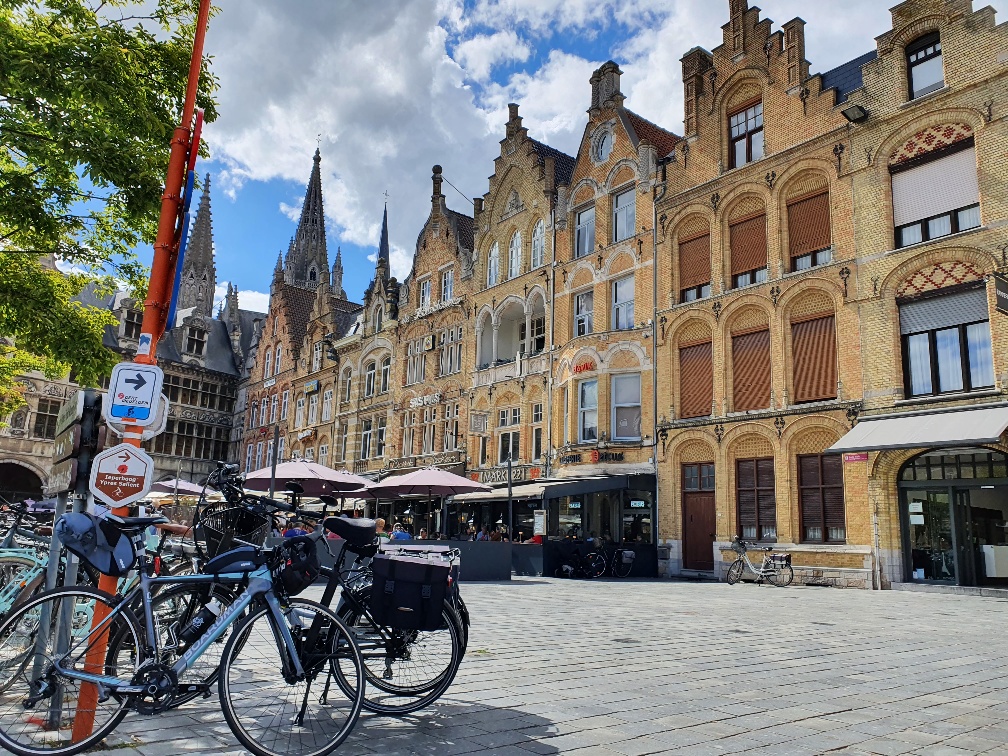
Onwards to Ypres, which was a very stylish looking town. I had picked a good day to go there as there was a mini fairground and a music festival taking place. 

So in the main square where I took my snack, visitors were serenaded with alternate world music and techno music from a nearby stage - quite an eclectic mix - especially when sung in Flemish.

Up to this point my ride had been on flat terrain through the Nord region of France, and West Flanders region of Belgium. When heading back into France, my route took me into the French-speaking Wallonia area where the terrain became undulating, with more varied flora and a feeling of familiarity as people spoke a language I could understand.

My re-entry back into France was somewhat unceremonious, as I rode along a small residential back-street in the back of beyond, near a Armentières, famous for its World War I war graves. This rough road, which was in fact not much more than a bumpy dirt track was signalled as a cul-de-sac, though there was access with a bicycle over a mini bridge. It was on the other side of this, and near a motorway, that a small sign showed that I was in France, and I noted that the registration number of the cars changed to the French format.

Ypres main square

Around an hour later, after riding along some quiet secondary roads, I was in the northern Metropole of Lille. Again, there was a buzzing atmosphere, partly because it had been a glorious summer's day, and I also imagine the buzz of welcoming the Tour de France in a few days' time.

My day-long ride from Calais to Lille, via Belgium had been very straightforward and pleasant. The bikepacking bags had survived - or at least I think I did. The final part of my journey on that Sunday was a local train from Lille to the picturesque old town of Saint-Omer, where I had a hotel booking. Bear in mind that old town means lots of cobbles. And in Saint-Omer there was no shortage of that. So once I had crossed the bridge over the canal, the bike bounced along the pave practically all the way up to the main square. As the hotel receptionist showed me to the store room where I could leave my bicycle, I heard some rattling in the saddle area. I removed the Koala saddlebag to see what was going on. To my shock the Exo-rail came off the saddle at the same time, and the saddle came loose! Oh dear. I guess, that's what happens when you don't use the right Allen Key to secure the saddle.

Luckily the following day I managed to ride the bike (albeit out of the saddle as there wasn't one to sit on!) down to the local Decathlon sports shop. The bike mechanic very helpfully put it back together using a heavy duty Allen Key and his own strength. It was a two-man job as I had to hold the saddle in place as he tightened the nuts. 

Saint-Omer, cathedral square

He hadn't heard of Alpkit and hadn't seen such an elaborate bikepacking system like this before as the Decathlon bike packing bags don't include any rails for the bag. He still believed that the Alpkit was a good system, but it was just a case of making sure that the screws in the saddle were properly tightened. So luckily, I was able to continue my planned cycle ride along Stage 3 of the Tour de France, back to Calais, where I could pick up the homeward ferry.

It was a fun weekend.

Once back home in London, I raised the issue with Alpkit customer services, and they very helpfully sent me a new rail and screw in case there was any further problem with the Exo-rail. I have since used it on other trips - for a ride to Paris, and in my local area in London and I haven't had any problem. So I look forward to doing more rides this year with the Alpkit bikepacking system. 

Pros: 

Weatherproof - kit stays dry in light rain

Easy to close and seal the bags

Fits tightly to the bike with little lateral movement of the bags

Exo-rail makes it easy to fit the Koala saddle bag onto the bike

Fuel pod is easy to reach while riding along

Cons:

Exo-rail is quite fiddly to fit; ensure that it is tightened properly with a firm and a good length Allen Key

Kuoka handlebar bag may be obstruct the brake/gear levers on small-sized handlebars; ensure that the bag is folded down small

Overall score for all items: 8/10


Related posts

Memories of bike rides in Argentina - Part 2

Eastern suburbs of Paris by bike

Short ride along the High Peak Trail

Sunday, 30 April 2023

The Monkey Motorbike Diaries - Episode 6: Dropping the bike

Just when you think you're getting the hang of it..... and you have that really embarrassing fall.

I am really enjoying riding my Honda Monkey, and I must say I even feel I have a bit of status because I ride my minimotorbike with no L-plates - unlike most other riders on small motorbikes and scooters around London.

I guess that comes with pros and cons. It's great that people can look at me and view me as someone who takes their motorbiking a little bit seriously, riding with all the correct protective gear, being responsible on the road, and not thrashing the bike around like a frisky teenager. 

But on the other hand, folks may also look at you like you are this really experienced bike rider. And then some of the newbies may even follow my line when filtering through traffic. Look, I'm just ad-libbing things and learning on the job. It may even be that some motorbikers with L-plates have been riding on the road for more years than I have been. The difference between us is just that they have chosen not to take the test for a full licence, preferring to renew their Compulsory Basic Training certificate every two years. So who knows they may actually be better bike riders than I even though they have L-plates. If that is the case, I am confident that it won't always be the case. I am determined to do all the courses and activities that will make me good, safe motorcyclist.

However, for now, I have to put up with those silly schoolboy errors. Top of the list of silly errors is dropping the bike when riding at a slow pace. I remember dropping the bike a couple of days after I bought the Monkey. It was pretty embarrassing, as I pulled into the driveway of my house and as I accelerated a little to get the bike to ride over the ramp in the kerb, I must have accelerated a bit too much and ended up losing control of the bike as there was a rapid surge in momentum. At that point me and the Monkey were in a heap on the pavement. 

Before I had time to think about any damage to the bike or my body, I focussed very quickly on getting back on my feet, hoping that nobody had seen what was a rather embarrassing fall. I picked myself up trying to style it out as though the tumble had been a planned action - not!

Apart from that, I hadn't had any mishap on the bike until now, when I was parking in a residential street next to Hampstead Heath to go to the Lido. It was a lovely sunny morning and I was enjoying riding down this tree-lined cul-de-sac with its Victorian red-brick houses. Finding a space on the other side of the road I did a very slow U-turn, then before I knew it, the bike lost momentum and wobbled. My gut reaction was to try and rescue the fall. But at this point I was already heading for the ground, and I was beyond rescue. Both me and the Monkey flipped sideways and I had hit the deck, with the bike lying on top of my leg. The engine continued running for a few seconds more before stalling.

I didn't feel any pain as the thickness of my Kevlar trousers must have absorbed the force. Motorcycle gear is definitely worth investing in. I would have felt very embarrassed, but in fact my biggest issue was how to get up. The bike weighs 104kg, which is light compared with most motorcycles. Nevertheless, it felt like a tonne and I was completely unable to move it. I was trapped. The saving grace was that this was a small cul-de-sac, so no chance of traffic passing through. Unhelpfully, no pedestrians were coming through either.  So I was faced with the prospect of just lying there until someone could help me. 

Luckily, two young women emerged from one of the houses. When they saw me they looked shocked and at the same time mystified as to what to do. I asked if they could lift the bike for me. The younger woman bent down to reach the bike. I felt a little awkward as I didn't know how strong she would be, and I would've been horrified if she'd put her back out. 

"Thanks, that's great. I can do the rest now," I said to her as she tried to bring the bike into an upright position. All I had needed was for the bike to be lifted enough for me to remove my leg from underneath it. Then I could stand myself and the Monkey back up. I was really grateful for her help. "Are you alright?" She asked, looking quite worried for me. "Oh, I am fine. There's no harm done," I replied. At that moment a cycle courier on a scooter appeared from nowhere, and also asked if I was okay. Then I began to feel silly. When you're on an eye-catching bike like the Honda Monkey you should be able to walk the walk, not hit the deck!

"I'm totally fine," I replied. "I made a silly mistake when doing my U-turn. I just feel really embarrassed!"

"Don't worry about it. We've all done that. But you're okay, right?" The young man enquired. 

I told him I was fine, before he went along on his way and continued his day, as did the two women. 

A quick inspection of the bike showed no damage, apart from to the right wing mirror which had come loose. This road turned out to be a a convenient place to have a mishap as there was a Kwik-Fit garage right opposite. The guy quickly resolved the issue by screwing the wing mirror back on, and everything was fine. Of course I would be getting the bike checked over properly once I got home.

After that mini drama, I found a parking space a little further away, and swam my cares away at Parliament Hill Lido.

There was no harm done during this fall. Most bikers wouldn't class it as a fall, but as dropping the bike. It is said to be one of the most common incidents, and can happen to anyone regardless of experience. That's reassuring to hear, but what I need to do is to learn how to pick myself up after such incidents.  In fact, I must say that this "bike drop" is one reason to stick to mini-motos like the Monkey, and not get a larger bike. I need something I can easily lift in these instances, or at least any passer-by helping me can easily lift.

Better still, I should try not to drop the bike - or at least learn to style it out if I do drop it!


Related posts 

The Monkey Motorbike Diaries - Episode 5

The Monkey Motorbike Diaries - Episode 4

The Monkey Motorbike Diaries - Episode 3

Monday, 24 April 2023

Freewheeling: Is women's professional cycle racing in a good place?

Demi Vollering wins Liege-Bastogne-Liege @GettySport

Phew, it's been breathtaking watching how the races have unfolded during this year's Spring Classics races - those tough one-day races in northern France, Belgium and the Netherlands over windswept, sometimes cobbled, sometimes undulating terrain, often in the rain. No one must be more out of breath than SD Worx rider Demi Vollering, who completed the Ardennes Classics triple in scintillating style by winning the Amstel Gold, Flèche-Wallone, and Liège-Bastogne-Liege - a feat last achieved by her mentor and team Sports Director, Anna van der Breggen in 2017.

As women's professional cycling continues to grow and more is being done to achieve parity with men's cycle racing, it is worth doing a stop and check, and asking if women's professional cycle racing really is in a good place?


Vive Le Tour de France Femmes

It has been great to see that sports event organiser Amaury Sports Organisation (ASO) continue to add to its sports portfolio by staging the Paris-Roubaix Femmes and a Tour de France Femmes. Last year's renaissance competition caught the eye of millions as the women raced around the streets of Paris on that hot Sunday afternoon during Stage 1 in the last week of July, right before the men raced the traditional finale. For many, it was an emotional day to see a women's peloton starting the stage race using the infrastructure of the iconic cycle race - something for which the likes of former professional cyclist Kathryn Bertine, and others including multiple World Champion Marianne Vos have campaigned for decades.

ASO were very happy with the viewing figures in France, with 20 million viewers on France 2 and France 3 free-to-air television channels across the whole race. There were on average 2.25 million viewers per day, making an audience share of 26.4%, and notably 5.1 million during the showdown between Vollering and Annemiek Van Vleuten on the final stage, on La Super Planche des Belles Filles. Across Europe 14 million viewers in seven countries tuned into fee-paying Eurosport. Naturally ratings were solid in the Netherlands with audience share of its national TV station, NOS being 45% as fans tuned in to watch their compatriot heroes race their way onto the podium and don the winning jerseys - Van Vleuten in yellow, Vollering in polka dots, Vos in green, and Shirin Van Anrooij in white. 

British hopes would normally have been placed on the top road racer, Lizzie Deignan, who won the inaugural Paris-Roubaix Femmes, but she was away on maternity leave. That will have impacted on viewing figures on this side of the English Channel.

Stage 1 of 2022 revived Tour de France Femmes

Meanwhile in France, crowds came out in force along the road sides for key stages in Paris, on the gravel roads into Bar-sur-Aube during Stage Four, and at the finale on the slopes of the Vosgian mountain passes. But even Tour Director, Marion Rousse said that there were questions to be asked around the lack of roadside spectators on other stages.

In some cycle races, local schools get the children to come out of their classrooms to watch the race, and make some noise. That generally makes for good viewing to see crowds of young, excited faces and their high pitched cheers ring out loudly as the television cameras pan through the town centres. But with the Tour de France Femmes being in late July, many schools are already closed for the holidays. 


Growth is in the eyeballs of the beholder

Very importantly, the number of eyeballs on a race is a key factor in the growth of any sport. It's important to have the viewing figures, and it also looks good for viewers when they watch images of competitors battling it out in front of enthusiastic crowds. 

While sports fans avidly watch their athletic heroes performing well, they also like the stories and the characters behind the sport - the professional who was just a weekend warrior barely a year previously; the outspoken activist; the rivalries - between teams or even within a team; the bad boy/girl; the athlete making a come-back following a serious injury or illness.

The highly successful Netflix Formula 1 docusoap Drive to Survive has consistently attracted the same comment - "I don't follow F1; I don't know anything about motorsport; but I am fascinated by the characters and the stories."

Personally, I think we need a bit of that in cycling, and particularly in women's professional cycling. Cycling fans marvel on social media over who they believe to be the GOAT (greatest of all time) - be it Marianne Vos or Annemiek Van Vleuten in the modern era, Beryl Burton from the vintage times, or Jeannie Longo if they want to go for a controversial choice. Whoever your don't want athletes who when they are interviewed are just a bit too.....I dare say, "ordinary"! Many of these athletes just talk about their racing, their calendar, their strategy, and they will have been media-prepped to not stray off that line. That's all well and good for the purist fan. But a sport cannot live on purists alone. There needs to be an extra dimension that can attract a wider audience and give a wow factor - or at least a story that chimes with observers.

Marianne Vos, for many the GOAT

Recently, a camera crew on the famous Koppenberg climb on the route of the Tour of Flanders, asked a group of women riders to move out of the way so that they could film one of the top men's teams doing their training ride over the cobbles. 

The camera crew failed to recognise that among the women they budged out was a certain Lotte Kopecky - defending champion of the race, a native of Flanders (voted Flandrian of the Year) as well as being winner of other classics like Het Nieuwsblad and Strade Bianche, plus a multiple World and European Track cycling champion. 

I previously wrote an article in Rouleur magazine about a big sporting rivalry in the 1980s - not Borg and McEnroe, but Longo and Canins. Two of the best women riders of that era, who dominated the erstwhile Tour de France Feminin. Jeannie Longo was a former Alpine skier from the French Alps, while Maria Canins was a former cross country skier from the Italian Dolomites. A young firebrand demoiselle against la mamma volante (on account of her juggling her racing with being a mother). This rivalry filled column inches of the sports pages and garnered curious as well as dedicated fans to support team Longo or team Canins. Both women have reminisced whimsically about those days when they had their faces plastered on the front of popular sports newspapers like Gazzetto dello Sport or L'Equipe. Longo also appeared on sports shows on French television. 


Everybody loves a story - where is it? We need it! 

Among the sea of women's teams today, a couple of frontrunners have emerged in the race for World Tour supremacy, with both teams having a clutch of World and National Champions in their fold. I'm talking about Trek-Segafredo and SD Worx. Wouldn't things be spiced up if we had a Manchester City v Arsenal type rivalry going on?

While there are quite a few riders who have shown true grit on the road, there don't seem to be any real characters that do acts that go beyond sport. Cecilie Uttrup Ludwig's trademark effusive post-race interviews attract interest and have brought her a significant following, and a comparatively less well-known Canadian, Alison Jackson - the surprise winner of Paris-Roubaix Femmes - got people talking as much about her sporting achievement as for her post-race dances on social media. But it seems to be limited to that. Let's hope Alison wins a few more races.

In short, we see some great racing in the women's game and there are some outstanding riders. But we could do with more characters and back-stories to make the sport. That's what garners a wider interest than just pure sport, and what brings more eyeballs, and hence increasing TV deals, and sponsorship. We all want to see our favourite sport on television, but clearly given the costs of televising a sport event, there needs to be something in it for the organisers who would sell the rights, and the broadcast companies who purchase the rights, and ultimately the sponsors and advertisers who are hoping to get the visibility and the returns. 

There needs to be solid evidence that loads of people will watch the event on TV. The Tour de France Femmes last year was deemed a success in terms of viewing figures which is great, but that scenario needs to be replicated again and again across the collection of big races in the racing calendar. As annoying as it may be that a women's cycle race isn't shown on terrestrial TV, it has to be kept in mind that it's an ambitious expectation to see a race televised if viewing figures are measured in the thousands - which is not uncommon for some World Tour races -  rather than in the millions.  

Sadly, sponsorship was lacking when it came to the Women's Tour of Britain race. The week-long stage competition had been running since 2014, attracting the best riders in the world, and was a paragon of parity in sport, with the race being televised on terrestrial free-to-air TV in the UK, and offering over a 90,000-euro prize fund - equal to the men's Tour of Britain, and more generous than other World Tour races apart from the Ride London Classique, and the later revived Tour de France Femmes.

But the organisers, Sweetspot, could not sustain this model and find a company willing to become the headline sponsor once the OVO Energy sponsorship ended after 2019. The event took place in 2022 but without a headline sponsor, but this could not continue for 2023. With funds desperately needed following the departure of other sponsors of the winners' jerseys and a vehicle sponsor, crowd funding was set up to try to make up the £500,000 shortfall. Sadly, there was no light at the end of the tunnel for this year.

The organisers, hope to hold the race in 2024, but that remains to be seen. The Vårgårda one-day race in Sweden has been stopped altogether due to economic reasons. Meanwhile, the women's Vuelta a España race, which had been held over one or two days in the September (and known as the Challenge Madrid) has been brought forward to May and will be a week-long stage race. The inaugural women's United Arab Emirates Tour took place in February over four days, and two newish stage races - the Tour de Suisse and the Tour de Romandie continue to establish themselves in the women's racing calendar. The women's calendar is busier than ever with 27 races (including 13 stage races) on the calendar, up from 23 in 2022. This is a far cry from the 17 races (including four stage races) when the calendar was established in 2016.

On paper professional women appear to have significantly less racing to do than their male counterparts who have 20 one-day races and 15 stage races (of which three are three weeks long) on their calendar. But in fact a men's team has around 30 riders in its squad, with an average of 12 sports directors/associate sports directors, so they can run dual squads in parallel. Women's teams don't have the resources to do that, especially as many teams will have just one or two sports directors, and 15 riders to fill the calendar. It is not uncommon for teams to run overlapping squads, and some also have a development squad too, but still, athletes can quickly become maxed out in racing if there are any injury or illness issues. This was a problem for Trek-Segafredo, which led to Lizzie Deignan returning to racing slightly earlier than planned. 

Some of the smaller World Tour Teams have said that the changes in structure and conditions in women's professional racing - increased minimum wages, greater prize money, television coverage, maternity pay - are very welcome, even long overdue. However, this can only be sustained with more cash, which can be challenging to find and sustain.

In the words of a UK Prime Minister, "There is no magic money tree".


Hoping for a great future

As well as the unfortunate absence of a few races from the 2023, in the last couple of years teams have spectacularly folded, among them Team Virtu Cycling, Paule Ka, and B&B Hotels - which led to Chloe Hosking unexpectedly facing the prospect of an early retirement from racing. Lifeplus-Wahoo had previously been a World Tour team (when sponsored Trek), but sponsorship issues led to the outfit dropping down to a Continental team status. As for Zaaf Cycling Team, this has been a catastrophe with several riders leaving, including French National Champion Audrey Cordon-Ragot (who had also been a casualty of the B&B Hotels fall-out) after there were reports of riders and staff not being paid.

Development in women's professional sport is always a good thing. But it is also important that any growth be sustainable. This apparent boom in women's professional cycle racing will do wonders for the future of the sport - for athletes, businesses, media, and inspiring more girls and women to get on a bicycle. But the proportionate financial support needs to be there to keep things going, and there needs to be an incentive for corporations to want to pour money into the sport. 

Serena Williams 

In my opinion, the incentive comes down to eyeballs - maybe a Megan Rapinoe moment, which raised the profile of women's football during the 2019 Fifa Football World Cup, or a Serena (Williams) Slam, circa 2003 and with the matching flamboyance and character - or is it sacrilege if I mention a Lance Armstrong moment - but without the industrial scale doping programme and bullying.

Megan Rapinoe at the 2019 football World Cup

Putting women's professional cycling properly on the map like sports such as football or tennis is easier said than done, at a time when professional women's cycle racing is finding its climbing legs. But I think the gains for the sport would be significant, and can move it from it's current reasonably good place, to a great place.


Related posts

52 Cycling Voices - 35: Kimberly Coats

52 Cycling Voices - 32: Emma Wade

Farewell Look Mum No Hands!

Le Tour de France Femmes est Arrivee